The horse / by William Youatt ; with a treatise on draught by I.K. Brunel ; and an appendix intended to advance the work to the present state of veterinary science by W.C. Spooner.
- William Youatt
- Date:
- [1831]
Licence: Public Domain Mark
Credit: The horse / by William Youatt ; with a treatise on draught by I.K. Brunel ; and an appendix intended to advance the work to the present state of veterinary science by W.C. Spooner. Source: Wellcome Collection.
Provider: This material has been provided by The University of Glasgow Library. The original may be consulted at The University of Glasgow Library.
81/562 page 67
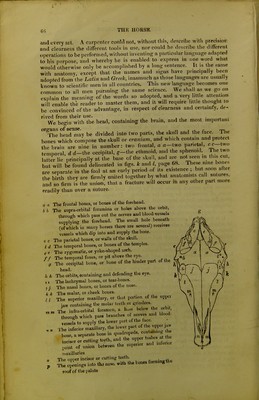
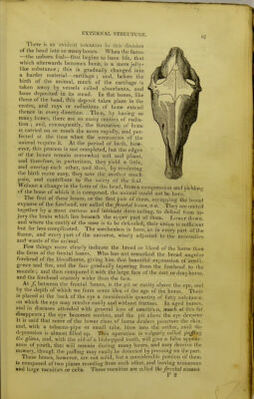
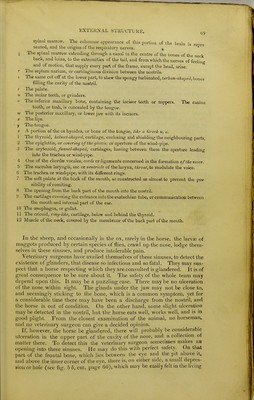
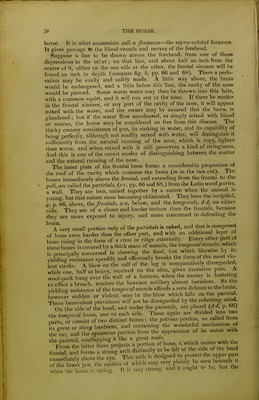
![There is an eviiienl iislfiilion in Uiis division of the iiead into so many bones. When the foetns —the unborn foal—first begins to liave life, that which afterwards becomes bone, is a mere jelly- like substance; this is gradually changed into a harder material—cartilage ; and, before the birth of the animal, much of the cartilage is taken away by vessels called absorbents, and bone deposited in its stead. In flat bones, like those of the head, this deposit takes place in the centre, and rays or radiations of bone extend thence in every direction. Then, by having so many bones, there are so many centres of radia- tion ; and, consequently, the formation of bone Ks carried on so much the more rapidly, and per- fected at the time when the necessities of the animal require it. At the period of birth, how- ever, this process is not completed, but the edges of the bones remain somewhat soft and pliant, and therefore, in parturition, they yield a little, and overlap each other, and thus, by rendering the birth more easy, they save the motlicr much pain, and contribute to the safety of the foal. Without a change in the form of (lie head, from a compression and yieldinrr of the bone of which it is composed, the animal could not be born. The first of these bones, or the first pair of them, occupying the broad expanse of the forehead, are called the frontal bones, a a. They are united together by a most curious and intricate dove-tailing, to defend from in- jury the brain which lies beneath the ujiper part of them. Lower down, and where the cavity of the nose is to be defended, their union is sufficient but far less complicated. The mechanism is here, as in every part of the frame, and every part of the universe, wisely adjusted to the necessities and wants of the animal. Few things more clearly indicate the breed or blood of the horse than the form of the frontal bones. Who has not remarked the broad anguUir forehead of the bloodhorse, giving him that beautiful expression of intelli- gence and fire, and the face gradually tapering from the forehead to the muzzle ; and then compared it with the large face of the cart or dray horse, and the forehead scarcely wider than the face. At /, between the frontal bones, is the ])it or cavity above the eye, and by the depth of which we form some idea of the age of the horse. There is placed at the back of the eye a considerable quantity of fatty substance, on which the eye may revolve easily and witliout friction. In aged horses, and in diseases attended with general loss of condition, much ef this fat disappears ; the eye becomes sunken, and the pit ahove the eye deej)cns It is said that some of the lower class of horse dealers puncture the skin, and, with a tobacco-pipe or small tube, blow into the orifice, imtil the depression is almost filled up. This operation is vulgarly called pvjfflng the glims, and, with the aid of a bishopped tooth, will give a false appear- ance of youth, that will remain during many hours, and may deceive the unwary, though the puffing may easily be detected by pressing on the part. These bones, however, are not solid, but a considerable portion of then, is composed of two plates receding from each other, and leaving n\nnerous and krge vacuities or cells. These vacuities are cdled the frontal sinusal F 2](https://iiif.wellcomecollection.org/image/b21459241_0081.jp2/full/800%2C/0/default.jpg)
 No text description is available for this image
 No text description is available for this image
 No text description is available for this image