Northumbrian crosses of the pre-Norman age / by W.G. Collingwood.
- W. G. Collingwood
- Date:
- 1927
Licence: Public Domain Mark
Credit: Northumbrian crosses of the pre-Norman age / by W.G. Collingwood. Source: Wellcome Collection.
14/212 page 2
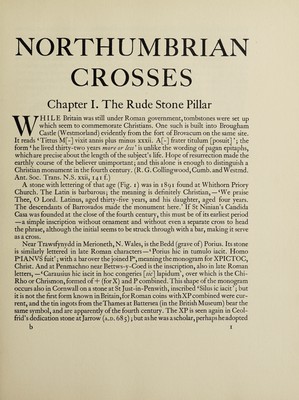
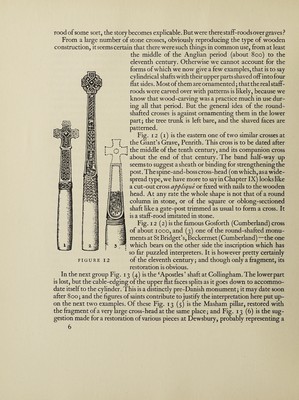
![the earlier form with antiquarian intent. On the whole the + P is the later, and its use in the stones we have next to consider suggests that they are by no means so early as the monument of Latinus. Fig. 2 gives the rude pillar at Kirkmadrine in the Rhynns of Galloway inscribed ‘A et (traces of Omega formerly visible). Hie iacent s[an]c[t]i et praecipui sacerdotes id es[t] Viventius et Mavorius’, with the + P monogram. The form of the A, which is not one of the many Roman types of A but common from the seventh century on¬ wards, suggestsa date not before the later part of the sixth. ‘The Kirkmadrine lettering is definitely later than that of the Paulinus and Vortipore stones (now at Carmarthen) r4ED l lAVP/wy* J LATIN VS i A//VORv« XXXV ET flUASVA AAA/1 V l |C^N/VAA|i fECERvT |« Ni?VS % 1 BARRova] l.Whithcrn HjCIACEl<r jCIETPRAE CIPVISACER DOTESIDE \VIVEATlV (Er/WVORIV^I 2 Kirkmadrine IHITIUTl EfFlHlS $ Kirkmadrine FIGURES I~5 of the middle sixth century ’ (R. G. Collingwood, Trans. Dumfriesshire and Gallo¬ way Ant. Soc. 3rd ser. X, 210). Fig. 3 represents another stone to [ — ]s and Floren- tius at the same place, and Fig. 4 is a later example in which ‘ Initium et finis ’ means the same as the ‘Alpha et Omega’ of Fig. 2. It is later because the monogram is a coarsened form, and the joined minuscules ‘urn’ and the shape of the N carry us away further from the Roman uncials of the first Christian period. Wearenowintheseventn century and these rude stones introduce us to the oldest of the Northumbrian crosses. Sometime after 660, when King Oswiu conquered the south of what is now Scot¬ land, Anglian settlers began to inhabit Galloway. Before Bede finished his Ecclesias¬ tical History (a.d. 731) there were so many of them that they had needed a bishop of their own race, and Pecthelm was appointed to the see, which was held by the Angl es till 802. We have no record of the circumstances of this settlement except what we gather from the Whithorn monument (Fig. 5). This, however, tells us much. It bears the same Galloway Chrismon, later and further developed, and the words ‘[L]oc[us] Sti. Petri Apustoli’, as much as to say, the old place of St Martin and St](https://iiif.wellcomecollection.org/image/b31350987_0014.jp2/full/800%2C/0/default.jpg)


 No text description is available for this image
 No text description is available for this image
 No text description is available for this image