Watermarks in paper in Holland, England, France, etc. in the XVII and XVIII centuries and their interconnection / by W.A. Churchill.
- William Algernon Churchill
- Date:
- 1935
Licence: Public Domain Mark
Credit: Watermarks in paper in Holland, England, France, etc. in the XVII and XVIII centuries and their interconnection / by W.A. Churchill. Source: Wellcome Collection.
46/537 (page 42)
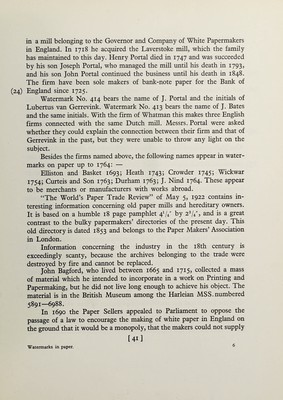
![the English market, and that many people who live by the foreign paper industry, and the publishing trade, would lose their livelihood. The Governor and Company of White Papermakers stated that the Sellers were defending the interests of France, and that the English manufact- (25) urers were brown paper makers. Until 1690 England paid £ 100,000 annually for paper to France (26) and Holland. The Paper Sellers, who were monopolists, opposed the manufacture of white paper in England also because other sellers would buy from the national factories and not from the wholesale importers, whose trade accordingly would be seriously diminished. The monopolists were thus (25) advocating Free Trade rather than Protection. There were at the time seven monopolizing Paper Sellers in England. The Stationers joined in appealing to Parliament to obstruct the bill. At this juncture the French Ambassador intervened in support of the im- (25) porters of French paper. The word “COMPANY” has been found frequently as a water¬ mark on paper imported into England. The word may be intended for the East India Company, but more probably for the Company of White Papermakers mentioned above. The word being enclosed in a cartouche gives it the appearance of being a French watermark. FOOLSCAP In the beginning of the 17th C. writing paper was usually 12—13 inches in height and about 16 inches in width, folded in two, each half sheet measured about 12 by 8 inches. A common watermark on the paper was a jester in cap and bells. This was also the mark of John Spielman who began papermaking in 1588. The first edition of Shakespeare’s plays printed by Isaac Jaggard and Ed. Blount in 1623 was said to have been printed on paper with this mark. The successors of this firm stated that the paper for Shakespeare’s folios was imported from Holland. At that time the Dutch had not started the manufacture of fine white paper, but they traded in French, German and Swiss paper. As usual when a monarchy is succeeded by a republic, royal emblems are destroyed or removed, and it is said that Cromwell ordered the royal [42]](https://iiif.wellcomecollection.org/image/b31345736_0046.jp2/full/800%2C/0/default.jpg)