Studies in vocational diseases. I-II / by J.W. Schereschewsky ; prepared by direction of the Surgeon-General.
- Joseph W. Schereschewsky
- Date:
- 1915
Licence: Public Domain Mark
Credit: Studies in vocational diseases. I-II / by J.W. Schereschewsky ; prepared by direction of the Surgeon-General. Source: Wellcome Collection.
11/252 (page 9)
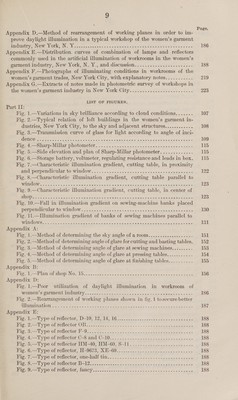
![2 Appendix D.—Method of rearrangement of working planes in order to im- prove daylight illumination in a typical workshop of the women’s garment e@listrye New. YOM aN. XY c.e ecu ce ss. <5 eee eS ee Obert Son Appendix E.—Distribution curves of combination of lamps and _ reflectors commonly used in the artificial illumination of workrooms in the women’s garment industry, New York, N. Y., and discussion. ...............--2....- Appendix F.—Photographs of illuminating conditions in workrooms of the women’s garment trades, New York City, with explanatory notes........... Appendix G.—Extracts of notes made in photometric survey of workshops in the women’s garment industry in New York City...................-.--.- LIST OF FIGURES. Part IT: Fig. 1.—Variations in sky brilliance according to cloud conditions. ...... Fig. 2.—Typical relation of loft buildings in the women’s garment in- dustries, New York City, to the sky and adjacent structures............ Fig. 3.—Transmission curve of glass for light according to angle of inci- RE eee ae re Sa lain aaa Ge eed fa thie Link ee Cae Riek tevet Plies er M1 Lar WNOLOMMCUCR. ied ciao sen ie wi dian asd ee nS eine atats.> < yeters Fig. 5.—Side elevation and plan of Sharp-Millar photometer. .......-.--- Fig. 6.—Storage battery, voltmeter, regulating resistance and leads in box. Fig. 7.—Characteristic illumination gradient, cutting table, in proximity Mn De PPC MCCUE LO WIMCOW 6 oe oe crake a been hainle 5.4 A mete Suemeumaemnd Fig. 8.—Characteristic illumination gradient, cutting table parallel to gd SS ane epee ee RE a eee eer ee ee Fig. 9.—Characteristic illumination gradient, cutting table, in center of CN ate te ake ge cI Sle ana aes ee ha ee nga Fig. 10.—Fall in illumination gradient on sewing-machine banks placed etpcnchotlar LorwINGOW < 20 cia: owe ced aso oni es Se hi eea en oee Fig. 11.—I]lumination gradient of banks of sewing machines parallel to DREISER at kk aly in ee ene Aa ate Appendix A: . Fig. 1.—Method of determining the sky angle of a room.................-- Fig. 2.—Method of determining angle of glare for cutting and basting tables. Fig. 3.—Method of determining angle of glare at sewing machines..:.....- Fig. 4.—Method of determining angle of glare at pressing tables..........- Fig. 5.—Method of determining angle of glare at finishing tables.......... Appendix B: Ee eee =e TORE OR SHOUT NOs C0ia <6 5 a cloe < hibis tats «ais Pals one aera a bee cas Appendix D: Fig. 1.—Poor utilization of daylight illumination in workroom of PPOMAOR Seumilcmt MIUMOLEY oo. eee eg eS oe eee hae 0 nae Fig. 2.—Rearrangement of working planes shown in fig. | tosecure better cL ICNP 0 lean enti age ae Ss Na ea REE sm IE Appendix E: ) Fig. 1.—Type of reflector, D-10, 12, 14, 16............... PE MS EO Map 2eo 1 Vepe Or Temeclor ©) bite geen ee cee en 28s Eee tales eT EN BA or Ve OP CM CCUOE Ge ote ose h ecw p chai n+ os eynsean ed 4 EE ES = Oe Fay 4 Type of reticctor C-8 and C-10. 8. 3 dice oe inie wae wenn d sina Sbels Se Fig. 5.—Type of reflector HM-40, HM-60, S-ll.............-.-2.-2.-.0. Big Gl ype or reuectwor, He y0is,. N00) ois. i gl ee pe Behe ea ls Hig; (.--bype of Tenector, Ome-mall UM... 6... 62 a. Seo 2s he pecan 4 cee ag 45.0 Pe Ol TOnCCIOE 19ers T ea Pega vie On FCHCCWOL, NANCY . 056s. tovetneee nic eae beg abla ee cee eSs emg Page. 186 188 219 223 107](https://iiif.wellcomecollection.org/image/b32854948_0011.jp2/full/800%2C/0/default.jpg)