Volume 1
A history of the earth, and animated nature / By Oliver Goldsmith. With an introductory view of the animal kingdom, tr. from the French by Baron Cuvier. And copious notes embracing accounts of new discoveries in natural history: And a life of the author by Washington Irving. And a carefully prepared index to the whole work.
- Oliver Goldsmith
- Date:
- 1847
Licence: Public Domain Mark
Credit: A history of the earth, and animated nature / By Oliver Goldsmith. With an introductory view of the animal kingdom, tr. from the French by Baron Cuvier. And copious notes embracing accounts of new discoveries in natural history: And a life of the author by Washington Irving. And a carefully prepared index to the whole work. Source: Wellcome Collection.
18/660
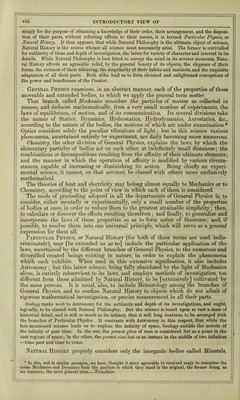
![simply for the purpose of obtaining a knowledge of their order, their arrangement, and the disposi- tion of their parts, without referring effects to their causes, it is termed Particular Physics, or Natural History. It thus appears, that while Natural Philosophy is the ultimate object of science. Natural History is the source whence all science must necessarily arise. The former is unrivalled for sublimity of ideas and depth of investigation, the latter for variety of character and interest in its details. While Natural Philosophy is best fitted to occupy the mind in its severer moments. Natu- ral History affords an agreeable relief, by the general beauty of its objects, the elegance of their forms, the richness of their colouring, the singularity of their habits and instincts, and the exquisite adaptation of aU their parts. Both alike lead us to form elevated and enlightened conceptions of the power and beneficence of the Creator. General Physics examines, in an abstract manner, each of the properties of those moveable and extended bodies, to which we apply the general term matter. That branch called Mechanics considers the particles of matter as collected in masses, and deduces mathematically, from a very small number of experiments, the laws of equilibrium, of motion, and of its communication. Its several divisions take the names of Statics, Dynamics, Hydrostatics, Hydrodynamics, Aerostatics, &c., according to the nature of the bodies, the motions of which are under examination.* Optics considers solely the peculiar vibrations of light; but in this science various phenomena, ascertained entirely by experiment, are daily becoming more numerous. Chemistry, the other division of General Physics, explains the laws, by which the elementary particles of bodies act on each other, at indefinitely small distances; the combinations or decompositions resulting from the affinity of their ultimate elements; and the manner in Avhich the operation of affinity is modified by various circum- stances, capable of increasing or diminishing its action. Being chiefly an experi- mental science, it cannot, on that account, be classed with others more exclusively mathematical. The theories of heat and electricity may belong almost equally to Mechanics or to Chemistry, according to the point of view in which each of them is considered. The mode of proceeding adopted in all the departments of General Physics is, to consider, either mentally or experimentally, only a small number of the properties of bodies at once, in order to reduce them to the greatest attainable simplicity; then, to calculate or discover the effects resulting therefrom; and finally, to generalize and incorporate the laws of these properties so as to form series of theorems; and, if possible, to resolve them into one universal jirinciple, which will serve as a general expression for them all. Particular Physics, or Natural History (for both of these terms are used indis- criminately), may [be extended so as to] include the particular application of the laws, ascertained by the different branches of General Physics, to the numerous and diversified created beings existing in nature, in order to explain the phenomena which each exhibits. When used in this extensive signification, it also includes Astronomy; but this latter science, being fully elucidated by the light of Mechanics alone, is entirely subservient to its laws, and employs methods of investigation, too different from those admitted by Natural History, to be [extensively] cultivated by the same persons. It is usual, also, to include Meteorology among the branches of General Physics, and to confine Natural History to objects which do not admit of I rigorous mathematical investigation, or precise measurement in all their parts. Geology ranks next to Astronomy for the sublimity and depth of its investigations, and ought, logically, to be classed with Natural Philosophy. But the science is based upon so vast a mass of historical detail, and is still so much in its infancy, that it will long continue to be arranged with the branches of Particular Physics. It contrasts with Astronomy in this respect, that while the last-mentioned science leads us to explore the infinity of space. Geology unfolds the secrets of the infinity of past time. In the one, the 'present place of man is considered but as a point in the vast regions of space; in the other, the present time but as an instant in the middle of two infinities —time past and time to come. Natural History properly considers only tbe inorganic bodies called Minerals, * In this, and in similar passages, we have thought it more agreeable to received usage to transpose the terms Mechanics and Dynamics from the position in which they stand in the original, the former being, as I we conceive, the more general term Translator. i.L^- J](https://iiif.wellcomecollection.org/image/b22014457_0001_0018.jp2/full/800%2C/0/default.jpg)