Notes on dental porcelain : a practical treatise especially devoted to the interests of the beginner.
- Gilbert, V. Walter
- Date:
- 1906
Licence: Public Domain Mark
Credit: Notes on dental porcelain : a practical treatise especially devoted to the interests of the beginner. Source: Wellcome Collection.
Provider: This material has been provided by the Augustus C. Long Health Sciences Library at Columbia University and Columbia University Libraries/Information Services, through the Medical Heritage Library. The original may be consulted at the the Augustus C. Long Health Sciences Library at Columbia University and Columbia University.
43/144 page 39
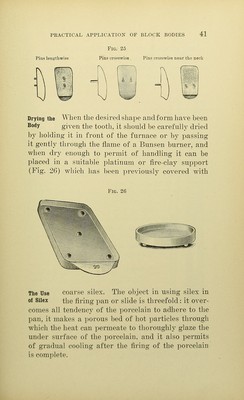
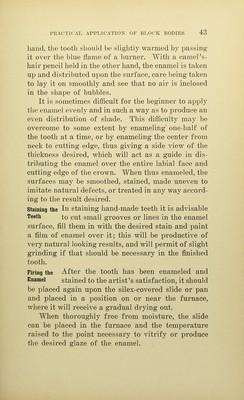
![mend definite proportions of each for the production of definite results; but such is not the case, and there- fore little or no reliance can be placed in formulas generally found in text-books. If the reader desires to manufacture block bodies, there is only one satisfactory way to do it, and that way is to test all the varieties of the raw materials he can find, select the variety of each best suited to his needs, and compound them in varying proportions and by differ- ent methods until the desired result is obtained, keep- ing careful record of each experiment as made. Practical Ap- The technic of making an artificial tooth plication of by hand may be described as follows: A Block Bodies p]aster impression of the adjoining and oc- cluding teeth, and models from the same are made in the usual way. The models should be thoroughly varnished and then oiled slightly, preferably with olive oil, in order to permit the easy removal of the porcelain after the carving has been done. The body can be mixed first upon a porcelain or glass slab and then in the palm of the hand, work- ing it with a bone spatula or the fingers until it is free from air bubbles and of a consistence similar to putty. Take enough of the mixed body to fill the edentulous space, and with a suitable carving tool carve the body to the desired shape, making allow- ance for shrinkage, which should be about 20 per cent. The amount of shrinkage and strength of the finished tooth will depend greatly upon the amount of water which is in the putty-like mixture and the manner in which it is used during the carving. In order to secure the minimum amount of shrinkage, the mixture should be as dry as it is practical to work it and it should be condensed as much as possible. In order to work the body fairly stiff without causing dry](https://iiif.wellcomecollection.org/image/b21221170_0043.jp2/full/800%2C/0/default.jpg)



 No text description is available for this image
 No text description is available for this image
 No text description is available for this image