An eulogium, intended to perpetuate the memory of David Rittenhouse, late president of the American Philosophical Society, delivered before the Society in the First Presbyterian Church, in High-Street, Philadelphia, on the 17th Dec. 1796 ... / [Benjamin Rush].
- Benjamin Rush
- Date:
- [1796]
Licence: Public Domain Mark
Credit: An eulogium, intended to perpetuate the memory of David Rittenhouse, late president of the American Philosophical Society, delivered before the Society in the First Presbyterian Church, in High-Street, Philadelphia, on the 17th Dec. 1796 ... / [Benjamin Rush]. Source: Wellcome Collection.
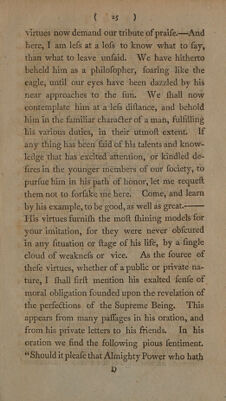
30/56 page 26
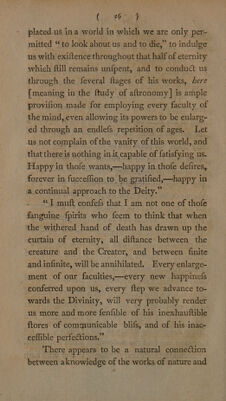
![(ie ¢e ce} placed.us ina world in which we are only per- mitted “to look about us and to die,” to indulge us with exiftence throughout that half of eternity which ftill remains unfpent, and to conduct us through the feveral ftages of his works, here [meaning in the ftudy of aftronomy] is ample provifion made for employing every faculty of the mind, even allowing its powers to be enlarg- ed through an endlefs repetition of ages. Let us not complain of the vanity of this world, and that there is nothing in it capable of fatisfying us. Happy in thofe wants,—happy in thofe defires, forever in fucceffion to be prac: RPP LA in a.continual approach to the Deity.” “T muft confefs that I am. not one of thofe fanguine fpirits who feem to think that when : the withered hand of death has drawn up the curtain of eternity, all diftance between the creature and the Creator, and between finite and infinite, will be annihilated. Every enlarge- ment of our faculties,—every new happinedfs conferred upon us, every ftep we advance to- wards the Divinity, will very probably render us more and more fenfible of his inexhautftible ftores of communicable blifs, and of his: inac- ceflible perfections.” | a There appears to be a natural conneGtion between aknowledge of the works of nature and](https://iiif.wellcomecollection.org/image/b2934105x_0030.jp2/full/800%2C/0/default.jpg)