Theatre hygiene : a scheme for the study of a somewhat neglected department of the public health / by Walter E. Roth.
- Roth, Walter E. (Walter Edmund), 1861?-1933.
- Date:
- 1887
Licence: Public Domain Mark
Credit: Theatre hygiene : a scheme for the study of a somewhat neglected department of the public health / by Walter E. Roth. Source: Wellcome Collection.
Provider: This material has been provided by London School of Hygiene & Tropical Medicine Library & Archives Service. The original may be consulted at London School of Hygiene & Tropical Medicine Library & Archives Service.
39/56 page 39
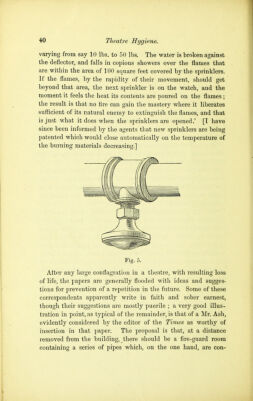
![Such being the case, we must look round for some ap- paratus that is independent of human assistance, that will always be ready, will never sleep, and will invariably act when required. The nearest approach that has as yet been made to perfection is the automatic method already generally introduced into the larger English warehouses, but up to the present, as far as I am aware, only into one English theatre. A modification of this system of fire-extinction for theatres has been patented by a Mr. Sinclair, whose invention, which I consider a most important one, may be shortly described as follows : ' It consists,* Firstj of an independent water-supply from the water-mains in the street, or from a tank at the top of the building kept for fire-extinction only. ' Secondly, of a system of pipes to lead the water from the main supply and placed at intervals of 10 feet across, the ceiling; the leading pipe connecting the system with the mains is 4 inches in diameter, and the pipes running across the ceiling 1| inches to 1| inches. ' Thirdly, of a series of sprinkler heads, about the size of an egg, screwed into the smaller pipes at intervals of ten feet, so that each sprinkler commands all fire within an area of 100 square feet on the floor.' [Of course the sprinkler heads could be fixed on the walls, etc., in connection with leading pipe, where they would be equally efficient.] ' These sprinklers consist of a plate and a deflector. The plate is kept in its place by means of bismuth solder. The deflector is for the purpose of breaking the column of water into spray, which falls in a dense shower over the flames. The supply of water is regulated by an automatic valve which moves the moment a sprinkler begins to act, and is in connection witli a fire-alarm. Immediately the flames and heat ascend, the bismuth solder, which is set to melt at any fixed temperature, say 160° F., melts and liberates the plate on the sprinkler nearest the fire, the water in the pipes rushes after it, and falls upon the deflector with the force that is behind it; «• Pall Mall Gazette, June, 1887.](https://iiif.wellcomecollection.org/image/b24398524_0039.jp2/full/800%2C/0/default.jpg)