On conditions necessary to obtain a clean milk supply and on methods of testing cows' milk in relation to standards of cleanness : report to the Sub-committee on clean milk / by S. Delépine, June 16th, 1918.
- Auguste Sheridan Delépine
- Date:
- 1918
Licence: In copyright
Credit: On conditions necessary to obtain a clean milk supply and on methods of testing cows' milk in relation to standards of cleanness : report to the Sub-committee on clean milk / by S. Delépine, June 16th, 1918. Source: Wellcome Collection.
69/116 page 65
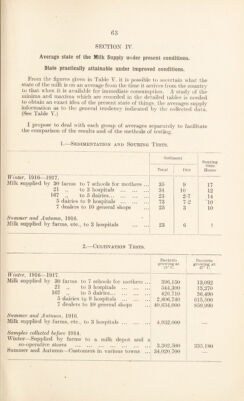
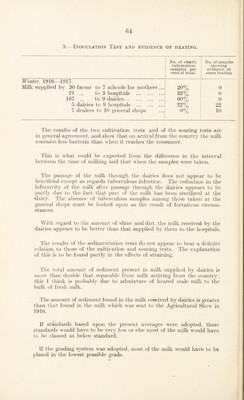
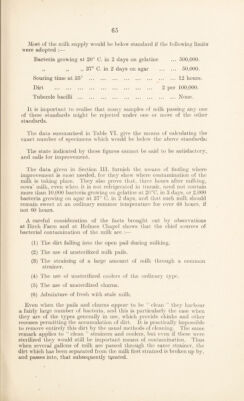
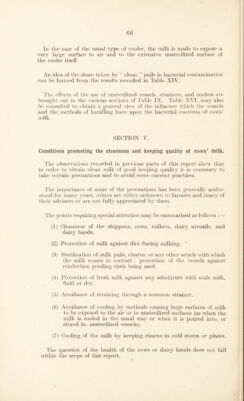
![Most of the milk supply would be below standard if the following limits were adopted :— Bacteria growing at 20° C. in 3 days on gelatine ... 500,000. ,, ,, ,, 37° C. in 2 days on agar . 50,000. Souring time at 35° .12 hours. Dirt . 2 per 100,000. Tubercle bacilli .None. It is important to realise that many samples of milk passing any one of these standards might be rejected under one or more of the other standards. The data summarised in Table VI. give the means of calculating the exact number of specimens which would be beloAV the above standards? The state indicated by these figures cannot be said to be satisfactory, and calls for improvement. The data given in Section III. furnish the means of finding where improvement is most needed, for they show where contamination of the milk is takmg place. They also prove that, three hours after milking, cows’ milk, even when it is not refrigerated in transit, need, not contaui more than 10,000 bacteria growing on gelatine at 20°C. in 3 days, or 2,000 bacteria growing on agar at 37° C. in 2 days, and that such milk should remain sweet at an ordinary summer temperature for over 48 hours, if not 60 hours. A careful consideration of the facts brought out by observations at Birch Farm and at Holmes Chapel shows that the chief sources of bacterial contamination of the milk are :— (1) The dirt falling mto the open pail during milking. (2) The use of unsterilized milk pails. (3) The straining of a large amount of milk through a common strainer. (4) The use of unsterilized coolers of the ordinary type. (5) The use of unsterilized churns. (6) Admixture of fresh with stale milk. Even when the pails and churns appear to be “ clean” they harbour a fairly large number of bacteria, and this is particularly the case when they are of the types generally in use, which ]3rovide chinks and other recesses permitting the accumulation of dirt. It is practically impossible to remove entirely this dirt by the usual methods of cleaning. The same remark applies to “ clean ” strainers and coolers, but even if these w^ere sterilized they would still be important means of contamination. Thus when several gallons of milk are passed through the same strainer, the dirt which has been separated from the milk first strained is broken up by, and passes into, that subsequently treated.](https://iiif.wellcomecollection.org/image/b29930303_0069.jp2/full/800%2C/0/default.jpg)