On conditions necessary to obtain a clean milk supply and on methods of testing cows' milk in relation to standards of cleanness : report to the Sub-committee on clean milk / by S. Delépine, June 16th, 1918.
- Auguste Sheridan Delépine
- Date:
- 1918
Licence: In copyright
Credit: On conditions necessary to obtain a clean milk supply and on methods of testing cows' milk in relation to standards of cleanness : report to the Sub-committee on clean milk / by S. Delépine, June 16th, 1918. Source: Wellcome Collection.
82/116 page 78
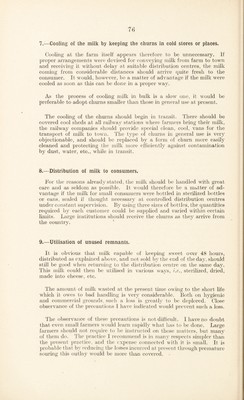
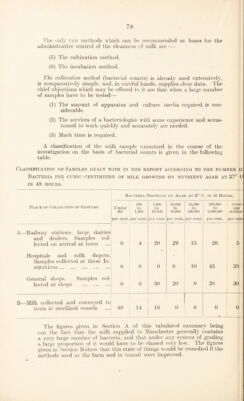
![only two methods which can be recommended as bases for the administrative control of the cleanness of milk are :— (5) The cultivation method. (6) The incubation method. The cultivation method (bacterial counts) is already used extensively, is comparatively simple, and, in careful hands, supplies clear data. The chief objections which may be offered to it a-re that when a large number of samples have to be tested— (1) The amount of apparatus and culture media required is con¬ siderable. (2) The services of a bacteriologist with some experience and accus¬ tomed to work quickly and accurately are needed. (3) Much time is required. A classification of the milk sample examined in the course of the investigation on the basis of bacterial counts is given in the following table. Classification of Samples deai.t with in the repoet ACCOEj:>iNG to the number o Bacteria per cubic centimetre of milk growing on nutrient agar at 37° C' in 48 hours. Bacteria Growing ON Agar at 37° C. in 48 Hours. Place of Collection of Samples Under 100 per cent. 100 to 1,000 per cent. 1,000 to 10,000 pur cent. 10,000 to 50,000 per cent. 50,000 to 100,000 per cent. 100,000 to 1,000,000 per cent. Over one million per cen A—Railway stations, large dairies and dealers. Samples cob lected on arrival at town 0 4 20 29 15 26 3 Hospitals and milk depots. Samxiles collected at these In¬ stitutions . 0 0 0 6 10 43 39 General shops. Samples col¬ lected at shops . 0 0 30 20 0 20 30 B—]y[ilk collected and conveyed to town in sterilized vessels 69 14 16 0 0 0 0 The figures given in Section A of this tabulated summary bring out the fact that the milk supplied to Manchester generally contains a very large number of bacteria, and that under any sj^stem of grading a large proportion of it would have to be classed very low. The figures given in Section B show that this state of things v'ould be remedied if the methods used at the farm and in transit ^vere improved.](https://iiif.wellcomecollection.org/image/b29930303_0082.jp2/full/800%2C/0/default.jpg)



 No text description is available for this image
 No text description is available for this image
 No text description is available for this image