Volume 1
History of the County Palatine and Duchy of Lancaster / By Edward Baines ... The biographical department by W.R. Whatton.
- Edward Baines
- Date:
- 1836
Licence: Public Domain Mark
Credit: History of the County Palatine and Duchy of Lancaster / By Edward Baines ... The biographical department by W.R. Whatton. Source: Wellcome Collection.
49/672 page 19
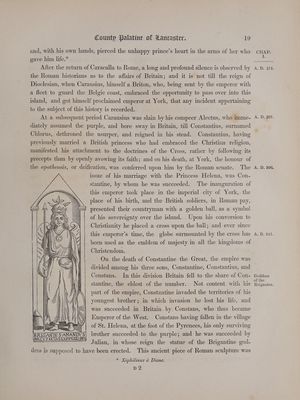
![and, with his own hands, pierced the unhappy prince’s heart in the arms of her who gave him life.* After the return of Caracalla to Rome, a long and profound silence is observed by the Roman historians as to the affairs of Britain; and it is not till the reign of Dioclesian, when Carausius, himself a Briton, who, being sent by the emperor with a fleet to guard the Belgic coast, embraced the opportunity to pass over into this island, and got himself proclaimed emperor at York, that any incident appertaining to the subject of this history is recorded. At a subsequent period Carausius was slain by his compeer Alectus, who imme- diately assumed the purple, and bore sway in Britain, till Constantius, surnamed Chlorus, dethroned the usurper, and reigned in his stead. Constantius, having previously married a British princess who had embraced the Christian religion, manifested his attachment to the doctrines of the Cross, rather by following its precepts than by openly avowing its faith; and on his death, at York, the honour of the apotheosis, or deification, was conferred upon him by the Roman senate. The issue of his marriage with the Princess Helena, was Con- stantine, by whom he was succeeded. ‘The inauguration of this emperor took place in the imperial city of York, the place of his birth, and the British soldiers, in Roman pay, presented their countryman with a golden ball, as a symbol of his sovereignty over the island. Upon his conversion to Christianity he placed a cross upon the ball; and ever since this emperor’s time, the globe surmounted by the cross has been used as the emblem of majesty in all the kingdoms of Christendom. On the death of Constantine the Great, the empire was divided among his three sons, Constantine, Constantius, and Constans. In this division Britain fell to the share of Con- stantine, the eldest of the number. Not content with his part of the empire, Constantine invaded the territories of his youngest brother; in which invasion he lost his life, and NSS was succeeded in Britain by Constans, who thus became Emperor of the West. Constans having fallen in the village Z NER \' - = _ We 4 ‘ as > MG | SY) K h A Me ~~ S iS / a] y Cee y] dis ii ws, CSELR= we 2 iif % ! 4 WOWNO RED'S R Wi 5 es \ EQ. GOS Wf.) WW. WQG\ DD35 ]= ESS titty WS. PE VB pe ZZ WY Jz = Uj SRE SAN R ZZ REAR MAA EAA NN < of St. Helena, at the foot of the Pyrenees, his only surviving uly BRIGANIE SERS brother succeeded to the purple; and he was succeeded by Julian, in whose reign the statue of the Brigantine god- dess is supposed to have been erected. This ancient piece of Roman sculpture was * Xiphilinus ad Dione. D2 CHAP. I. A.D. 211. A. D. 297. A. D. 306. A. D. 341. Goddess of the Brigantes.](https://iiif.wellcomecollection.org/image/b33521682_0001_0049.jp2/full/800%2C/0/default.jpg)