Report on the medical topography and statistics of the Presidency Division of the Madras Army : including Fort St. George, and its dependencies, within the limits of the supreme court. Compiled from the records of the Medical Board office.
- Madras. Medical Board Office.
- Date:
- 1842
Licence: Public Domain Mark
Credit: Report on the medical topography and statistics of the Presidency Division of the Madras Army : including Fort St. George, and its dependencies, within the limits of the supreme court. Compiled from the records of the Medical Board office. Source: Wellcome Collection.
Provider: This material has been provided by Royal College of Physicians, London. The original may be consulted at Royal College of Physicians, London.
21/152 page 1
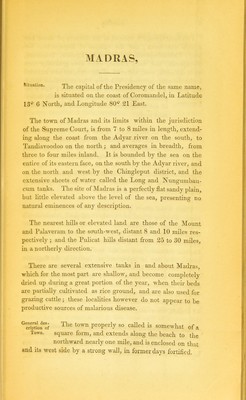
![MADRAS, Situation. capital of the Presidency of the same name, is situated on the coast of Coromandel, in Latitude 13® 6 North, and Longitude 80® 21 East. The town of Madras and its limits within the jurisdiction of the Supreme Court, is from 7 to 8 miles in length, extend- ing along the coast from the Adyar river on the south, to Tandiavoodoo on the north j and averages in breadth, from three to four miles inland. It is bounded by the sea on the entire of its eastern face, on the south by the Adyar river, and on the north and west by the Chingleput district, and the extensive sheets of water called the Long and Nungumbau- cum tanks. The site of Madras is a perfectly flat sandy plain, but little elevated above the level of the sea, presenting no natural eminences of any description. The nearest hills or elevated land are those of the Mount and Palaveram to the south-w^est, distant 8 and 10 miles res- pectively ] and the Pulicat hiUs distant fi:om 25 to 30 miles, in a northerly direction. There are several extensive tanks in and about Madras, which for the most part are shallow, and become completely dried up dui'ing a great portion of the year, when their beds are partially cultivated as rice ground, and ai-e also used for grazing cattle; these localities however do not appear to be productive sources of malarious disease. ‘^cripHon'o? properly so called is somewhat of a Town. square form, and extends along the beach to tlie northward nearly one mile, and is enclosed on that and its west side by a strong wall, in former days fortified.](https://iiif.wellcomecollection.org/image/b28406886_0021.jp2/full/800%2C/0/default.jpg)

 No text description is available for this image
 No text description is available for this image
 No text description is available for this image