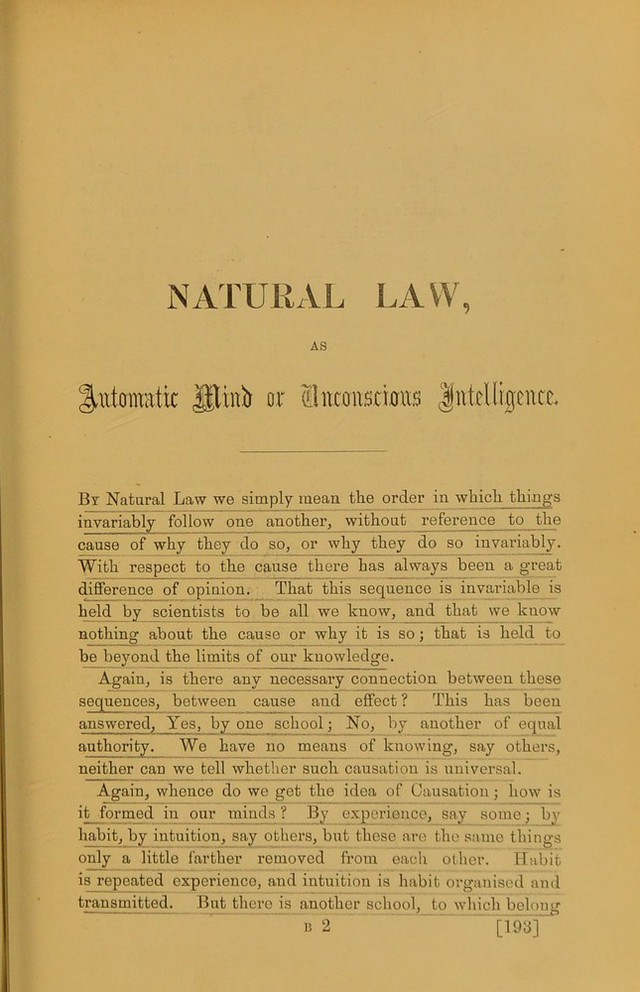
Natural law, as automatic mind or unconscious intelligence : read at a meeting of the Psychological Society of Great Britain / by Charles Bray.
- Charles Bray
- Date:
- [1877]
Licence: Public Domain Mark
Credit: Natural law, as automatic mind or unconscious intelligence : read at a meeting of the Psychological Society of Great Britain / by Charles Bray. Source: Wellcome Collection.
Provider: This material has been provided by The Royal College of Surgeons of England. The original may be consulted at The Royal College of Surgeons of England.
4/16 page 4
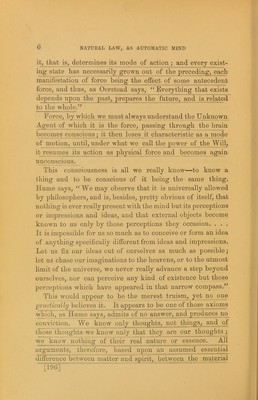
![Locke, Mill, and Mansel, who say that our idea of cause arises from analogy to our own voluntary actions. The generality of mankind expect the sun to rise from habit, few go so far as experience, that is, that it will do so because it always has done so, and fewer still ask what Power it is that makes it do so. But when we come to reason upon this “ power ” or cause, the only idea we have of it is the use we ourselves make of it in our own voluntary actions. The Persistence and Correlation of Force is the great discovery of the nineteenth century, and yet no sooner has it been made manifest that Force is as real, as measurable, as indestructible as matter, than all classes of both mental and physical philosophers are in a hurry to bury it again; and that which is proclaimed to be indestructible is never- theless said to be no entity. The physicist finds only “ motion,” the psychologist “ free will,” and both Materialist and Spiritualist equally find matter and spirit acting spon- taneously. No cause or force is required for the production either of motion or volition ; and the fact that there is such a thing as force, and that each manifestation of it can be interpreted only as the effect of some antecedent force, is practically ignored. The Materialist says, force or power is simply an innate principle or attribute of matter, or rather it is the physical motion itself, and the notion, or rather feel- ing, that power is a something distinct from matter, is an illusion, and the idea that matter would be inert except for something else pushing it behind, or carrying it along, is absurd. Thus the active principle, the cause of all change, is supposed to be inherent in matter itself, the same as psychologists affirm the active principle to be inherent in mind itself. The one party wishes to get rid of the invisible or spiritual principle in matter, the other to do without cause for volition, or what becomes of free will, and the interests of morality supposed to be based upon it ! ' [194]](https://iiif.wellcomecollection.org/image/b22443952_0006.jp2/full/800%2C/0/default.jpg)