Licence: In copyright
Credit: Dr. Walter Robert Hadwen's works. Source: Wellcome Collection.
Provider: This material has been provided by London School of Hygiene & Tropical Medicine Library & Archives Service. The original may be consulted at London School of Hygiene & Tropical Medicine Library & Archives Service.
295/324 page 7
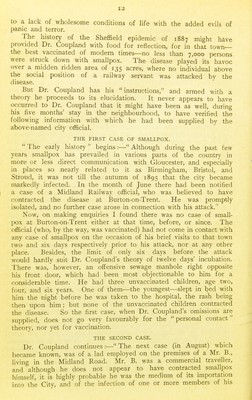
![all, it ought to have resisted it then. If cowpox cannot prevent smallpox when it is most active in the system, how in the world can it do so when its virulent effects are at an end and the vaccine vesicle has become a scar? Of those 86 cases no less than seven- teen had confluent attacks of smallpox; all but seven were over sixteen years of age. Had Dr. Coupland troubled to consider other factors in these results the solution would have been simple. RECENT VACCINATION NO GOOD. There is a further list of eighty-nine cases given by Dr. Coup- land of persons vaccinated for the first time within a fortnight of their falling ill with smallpox. The remarks at the close of the previous paragraph apply here also. But there is a striking admission by the official enquirer concerning these cases on page 151, namely, that it is not possible to assert from the history of these cases that vaccination had exerted a distinctly modifying influence upon the disease. In fact, the table shows just the opposite. Such an unexpectedly frank confession must be very disquieting to the army of pro-vaccinists who, for two generations, have indulged in and sedulously published dogmatic assertions of an opposite type. There were only fourteen cases of dis- crete smallpox (the mildest kino) in the whole list, and with the exception of thirteen very indefinitely labelled mild (what- ever that may mean), every case was either '' confluent or coherent smallpox, the type around which the battle of life and death concentrates. Two of these were malignant, both died, and. one of the latter had been successfully vaccinated a full fourteen days before contracting the disease. And yet this case, as with the whole eighty-nine amo.ng which were no less than twentv- seven deaths, are, at the behest of a whimsical medical fad, made to swell the lists of the unvaccinatecl sufferers of the Gloucester epidemic! The incidents of vaccine failure here recorded are precisely similar to those recorded by Dr. Woodville in the old London Smallpox Hospital nearly a hundred years ago, viz., that recently vaccinated persons caught the infection of smallpox just as readily and just as severely as if they had not been vaccinated, or had been vaccinated some time previously. Woodville said, he at first expected that cowpox inoculation would have anticipated'' the action of smallpox contagion, but, he adds: Numerous facts have, however, proved this opinion to have been unfounded, and that the variolous effluvia, even after the vaccine inoculation has made a considerable progress, have in several instances [he might have said ' many' according to his own appended table] occasioned an eruption resembling that of smallpox. Consequently, in his dilemma, he invented for the first time the excuse so readily resorted to subsequently by the medical profession, that some time must elapse after the operation before vaccination could be deemed protective. But the only conclusion which can, in my estimation,](https://iiif.wellcomecollection.org/image/b21361691_0295.jp2/full/800%2C/0/default.jpg)