Recent advances in the prevention and treatment of blowfly strike in sheep : supplement to report no. 2 / by the Joint Blowfly Committee (Appointed by the Council for Scientific and Industrial Research, the New South Wales Department of Agriculture, and the Queensland Department of Agriculture and Stock).
- Date:
- 1943
Licence: In copyright
Credit: Recent advances in the prevention and treatment of blowfly strike in sheep : supplement to report no. 2 / by the Joint Blowfly Committee (Appointed by the Council for Scientific and Industrial Research, the New South Wales Department of Agriculture, and the Queensland Department of Agriculture and Stock). Source: Wellcome Collection.
6/24 page 4
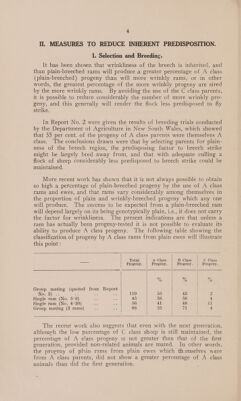
![Il. MEASURES TO REDUCE INHERENT PREDISPOSITION. 1. Selection and Breeding. It has been shown that wrinkliness of the breech is inherited, and than plain-breeched rams will produce a greater percentage of A class (plain-breeched) progeny than will more wrinkly rams, or in other words, the greatest percentage of the more wrinkly progeny are sired by the more wrinkly rams. By avoiding the use of the C class parents, it is possible to reduce considerably the number of more wrinkly pro- geny, and this generally will render the flock less predisposed to fly strike. In Report No. 2 were given the results of breeding trials conducted by the Department ot Agriculture in New South Wales, which showed that 55 per cent. of the progeny of A class parents were themselves A class. The conclusions drawn were that by selecting parents for plain- ness of the breech region, the predisposing factor to breech strike might be largely bred away from, and that with adequate culling a flock of sheep considerably less predisposed to breech strike could be maintained. More recent work has shown that it is not always possible to obtain so high a percentage of plain-breeched progeny by the use of A class rams and ewes, and that rams vary considerably among themselves in the proportion of plain and wrinkly-breeched progeny which any one will produce. The success to be expected from a plain-breeched ram will depend largely on its being genotypically plain, i.e., it does not carry the factor for wrinkliness. The present indications are that unless a ram has actually been progeny-tested it is not possible to evaluate its ability to produce A class progeny. The following table showing the classification of progeny by A class rams from plain ewes will illustrate this point: | i | Total A Class B Class | C Class pee Progeny. Progeny. Progeny. | Progeny. % % %o Group mating (quoted from Report IN O56) Ure He < e 119 55 43 2 Single ram (No. 5:6) ee es 45 38 58 | 4 Single ram (No. 4°30) ae - 56 4] 48 | Il Group mating (3 rams) 2 ve 68 25 ef! | 4 The recent work also suggests that even with the next generation, although the low percentage of C class sheep is still maintained, the percentage of A class progeny 1s not greater than that of the first generation, provided non-related animals are mated. In other words, the progeny of pliin rams from plain ewes which th:mselves were from A class parents, did not show a greater percentage of A class animals than did the first generation.](https://iiif.wellcomecollection.org/image/b3217584x_0006.jp2/full/800%2C/0/default.jpg)