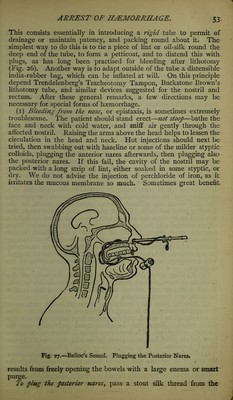
A surgical handbook : for the use of students, practitioners, house-surgeons, and dressers / by Francis M. Caird and Charles W. Cathcart.
- Caird, Francis M. (Francis Mitchell), 1853-1926.
- Date:
- 1894
Licence: Public Domain Mark
Credit: A surgical handbook : for the use of students, practitioners, house-surgeons, and dressers / by Francis M. Caird and Charles W. Cathcart. Source: Wellcome Collection.
77/322 (page 57)
![Dorsal Artery of the Downward pressure against the tarsus between the mid-point of the malleoli and the interval between the first and second metatarsal bones. Posterior Tibial. —Forward and outward pressure against the tibia, a thumb’s-breadth from the internal malleolus. Transfusion. The methods of injecting fluid directly into the veins of persons who are greatly reduced by loss of blood or wasting disease, have been, in recent times, revived and much discussed. The objects to be attained by such proceeding are these : either (i) To add fluid to the circulation, and so give the heart something on which to con- tract ; thus to enable it to utilise the blood which always remains in the veins after bleeding, and to stimulate absorption (water or saline fluids); (2) to add also nutriment to the blood (blood or milk); or (3) to add to it, besides fluid and nutriment, red blood-corpuscles, which will be functionally active as respiratory agents (blood). _ Of these, while the second is of doubtful value, and the third of doubtful possibility, the first is unquestionably possible, and is often all that is required to save life, especially after sudden haemorrhage. The effect produced has been called the “dynamic” effect. A-septic (boiled) water at blood-heat, injected to the amount of about 1 ]/z litre {2% pints) has been found sufficient in an apparently desperate case of post partum haemorrhage. A warm % per cent, solution ot common salt in boiled distilled water (about a drachm to the pint) would be preferable to plain boiled tap water. Various other saline solutions have also been recommended ; but it would be difficult to prove their practical advantage over either water or a ^ per cent* solution of common salt. Jennings advises the following :— Chloride of Sodium, 50 grs. Chloride of Potassium, 3 grs. Sulphate of Soda, 2*5 grs. Carbonate of Soda, 2*5 grs. Phosphate of Soda, 2 grs. Dissolve in 20 oz. water at ioo° F., and add 2 drachms of absolute alcohol. The great desideratum is simplicity of material and apparatus. In all cases of danger from sudden loss of blood, it is well to remember the great possible value of 15 or 20 ounces of boiled (a-septic) water at ioo° F., with or without saline addition. Apparatus Needed.—A nozzle of glass or metal, for tying into the vein of the recipient, will be needed, and a piece of tubing to attach it to the syringe or syphon. These, or their ready-made substitutes, ought to be procurable on most emergencies. The end of the nozzle, if cut obliquely, will enter the opening in the receiver s vein more easily. A bulbous end, advocated by some to make the tying in more secure, seems hardly necessary. Mode of Procedure.—(a.) In transfusion of water or saline solution.—Expose a large vein in the recipient—Median Basilic, for preference. Should it be invisible owing to anaemia, cut down over its usual site, and look for it. Pass a double catgut ligature under](https://iiif.wellcomecollection.org/image/b28055317_0077.jp2/full/800%2C/0/default.jpg)