Paris and environs with routes from London to Paris : handbook for travellers / by Karl Baedeker.
- Karl Baedeker
- Date:
- 1913
Licence: In copyright
Credit: Paris and environs with routes from London to Paris : handbook for travellers / by Karl Baedeker. Source: Wellcome Collection.
50/742 page 46
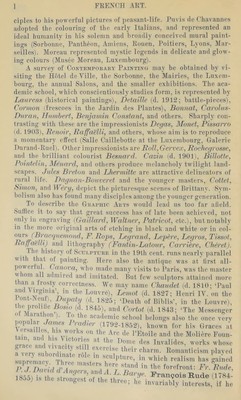
![‘Helol'se’. Greuze remains to this clay a iiojcular favourite, not on account of these moral pictures witli their hard colouring, but on account of his paintings of girls (‘The Broken Pitcher’; the ‘Milkmaid’, etc.), still showing traces of the sensuous charm of the preceding epoch. Greuze’s elder contemporarv, Jean Baptiste Simeon Chardin (1699-1779), was one of the best painters of still-life that ever lived, an excellent portrait-painter, and an acute, amiable, and original observer of simple domestic scenes (‘Grace’, the ‘Industrious Mother’, etc., in the Louvre). Tlie true jcrecursors of the later classicism were, however, lL‘e«,’the teacher of David, ('oeh'nij and Hubert Robert, witli liis views of Roman ruins. The rococo style lead little influence on the art of Scui.pture. Alleyrain, with his nymphs, and Clodion, with his terracotta groups of Bacchantes, Satyrs, and Cupids, touch on its outskirts in the grace and sensuousness of their style, but tlieir contemjiorary I3ou(diardou, the ‘Frencli Phidias’, with his Grenelle Fountain, and other sculptors may almost be called severe. Piyeille (1 714-85) pays homage to the ])ictorial taste of tlie ])criod in the tombs of Marshal Saxe (.Strassburg) and the Comte d’Harcourt (Notre-I)ame), and in tlie niouument of Louis XV. at Rheims, but he also expresses philosophical ideas in his allegories, and his love of the anticiue in the nude statue of Voltaire (p. 298). The amiable Pajou (1780- 1809) vacillates between antique severity and French grace, be- tween frivolity and sentiment, in his Pluto, his Bacchante, and his statue of (|ueen Marie Lesezinska as Caritas (in the Louvre). Similar vacillation is shown by Falconet, whose best works are in St. I’etersburg. Leiuoifiie (Louvre, Versailles) and. Cafperi ;^d.l792; l)usts of Rotrou, La Chaussee, J. B. Rousseau, etc.) are admirable portrait-sculptors, but both are far sur])assed by Jean Antoine Houdon (1741-1828), whose seated statue of Voltaire (]). 86) is one of the masterpieces of realistic portraiture, aud whose ‘Diana’ (bronze replica in tlie Louvre of the original marble in St. Peters- burg^ is one ol the most perfect nude figures iu modern art. I he transition to classicism was easiest in AuciiiTECTruE. That !i'* >’*1 Lishionable taste was abandoned is jiroved by by Rervaiidoni (1783), the iiortal of arclueologists Mariette aud - M .. Cavlus, at I’ompen and Herculaneum classical lendenev. Blondel (1756), aud the and above all the excavations all contributed to the victorv of the .^.avid U 748-1825) does not mark a revolution, as once supp„sed, but ra decade ol ilevelopment (‘llelisarius'. 17S1- M); ither the close of a Oath of the Horatii’,](https://iiif.wellcomecollection.org/image/b2901119x_0050.jp2/full/800%2C/0/default.jpg)


 No text description is available for this image
 No text description is available for this image
 No text description is available for this image