Paris and environs with routes from London to Paris : handbook for travellers / by Karl Baedeker.
- Karl Baedeker
- Date:
- 1913
Licence: In copyright
Credit: Paris and environs with routes from London to Paris : handbook for travellers / by Karl Baedeker. Source: Wellcome Collection.
54/742 page 50
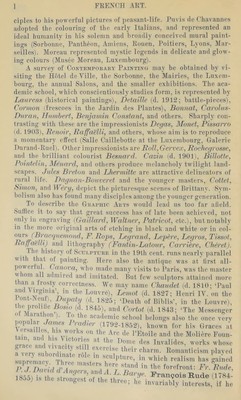
![FKEXf'H AKT. ciples to his powerful pictures of peasant-life. Puvis fie Chavannes adopted the colouring of the early Italians, and represented an ideal humanity in his solemn and broadly conceived mural paint- ings (Sorbonne, Pantheon, Amiens, Kouen, Poitiers, Lyons, Mar- seilles). Moreau represented mystic legends in delicate and glow- ing colours (Musee Moreau, Luxembourg). A survey of Contempokaky Paintixo may be obtained by vi- siting the Hotel de Ville, the Sorbonne, the Mairies, the Luxem- bourg, the afinual Salons, and the smaller exhibitions. The aca- demic school, which conscientiously studies form, is represented by Laurens (historical paintings), Dctallle (d. 1912; battle-pieces), Cormon (frescoes in the Jardin des Plantes), Bonnat, Carolus- Durnn, IJnmhert, Benjamin Constant, and others. Slnu-ply con- trasting with these are the impressionists Derfas, ^^onet, Pissan'o (d. 1903), Renoir, Raffaelli, and others, whose aim is to reproduce a momentary effect (Salle Caillebotte at the Luxembourg, Galerie Durand-Ruel). Other impressionists are RoIl.Gervex, Rochefirosse, and the brilliant colourist Besnard. Cazin (d. 19011, Billotte, !\nntelin, Menard, and otliers jiroduce melancholy twilight land- scapes. Jules Breton and LJiermitte are attractive delineators of rural life. Daifnan-Bouveret and the younger masters, Cottet, >Snno7i, and ]Veri/, depict the picturescpie scenes of Brittany. Sym- bolism also has found many disciples among the younger generation. To describe the Gkaphic Arts would lead us too far alield. Sulllcp it to say that great success has of late been achieved, not only in engraving [GaiUard, Waltner, Patricot, etc.), but notably in the more original arts of etching in black and white or in col- ours (Bracquemond, F. Pops, Leqrand, Leph'e, Legros. Tissot, Raffaelli) and lithography (Fantin-Latour, Carriere, Cheret). The history of Scui.ptuke in the 19th cent, runs nearly ]>arallel with that of painting. Here also the antique was at tirst all- l)owerful. Catiova, who made many visits to Paris, was the master w' lom all admired and imitated. Rut few sculptors attained more rosty correctness. We may name Chaudet (d. 1819; ‘Paul n i XT ■ T-v' Louvre), Lemot (d. 1827; Henri IV. on the ont-Acul), Dupatg (d. 1825; ‘Death of Biblis’, in the Louvre). r ‘Tin- Dlessenger o aia.ioji). o the academic school belongs also the once verv popular James I radier (1792-1852), known for his Graces a‘t than and Virginia tain, and hi \ ersailles, his works on iiie Arc de I’Etoile and the Moli6re Poun- e des Invalides, works whose d gained /) / i'l the forefront: Fr. Rude, I ../. uai Hi (i Angers, and A. L. Ban ts on the Arc de ,us Victories at the Dom grace and vivacity still a very subordinate role supremacy. Three masters her - v..,v exercise their charm. Romanticism playei in .s'culpture, in which realism has jiainec 1855) is the strongest of the three; h’ ge. Francois Rude (1784- invariably interests, if he](https://iiif.wellcomecollection.org/image/b2901119x_0054.jp2/full/800%2C/0/default.jpg)


 No text description is available for this image
 No text description is available for this image
 No text description is available for this image