Licence: Public Domain Mark
Credit: On social reforms needed in Scotland / by David Milne Home. Source: Wellcome Collection.
Provider: This material has been provided by the Royal College of Physicians of Edinburgh. The original may be consulted at the Royal College of Physicians of Edinburgh.
13/124 page 11
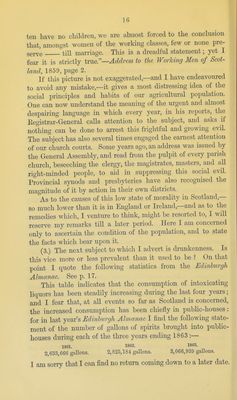
![Whether, owing to their having less hard work during the day, or from habits of industry and frugality, servants were accustomed to dedicate the winter evenings at the kitchen fire to some home manu- fixctures now unknown ; for instance, to giving the finishing work to their shoes. At that time none of the ploughmen, and few of the women-servants, purchased their shoes in a complete state. The shoes of the men, called brogues, had only a single sole. It was the custom of the purchasers to double, sometimes treble, the soles Avith their own hands. Servants and labourers were always provided Avith the necessary tools for this work. I find, with regard to the wages in Berwickshire, that so late as the year 1791, ablebodied men received for working in the fields only from 9d. to Is. per day, and house-servants from £6 to £7 yearly (mss. of George Home of Paxton). These facts show how scanty in former days were the means of personal comfort, compared with what are now possessed by the same classes of persons. I might refer to many other points bearing on the material or physical condition of our population in former days ; such as the scarcity of fuel (consisting of peats and fallen timber); the difficulty of moving from one part of the country to another; the severe distress which arose, not unfrequently from want of food, when harvests were deficient. But it is superfluous to enlarge further on these heads. Every one knows that, in re- spect of physical comforts and material advantages, the im- provements have been striking and extensive. 3. I come now to remark on the moral condition of the working classes. Is it better than it was, and is it now improving ? I am afraid that is a question which cannot be answered easily or satisfactorily. The evidence bearing on the moral condition of any class is necessarily less distinct than that bearing on its physical condition; and the evidence, such as it is, does not go back to a very remote period. But evidence there undoubtedly is to indicate, during the last thirty years, what has been the moral character of our ]3opulation, and to show the changes which have taken place during that time. The evidence I allude to](https://iiif.wellcomecollection.org/image/b21952486_0015.jp2/full/800%2C/0/default.jpg)

 No text description is available for this image
 No text description is available for this image
 No text description is available for this image