On the pigmentation of uric acid crystals deposited from urine / by Archibald E. Garrod.
- Garrod, Archibald Edward, 1857-1936.
- Date:
- 1894
Licence: Public Domain Mark
Credit: On the pigmentation of uric acid crystals deposited from urine / by Archibald E. Garrod. Source: Wellcome Collection.
Provider: This material has been provided by The Royal College of Surgeons of England. The original may be consulted at The Royal College of Surgeons of England.
10/12 page 106
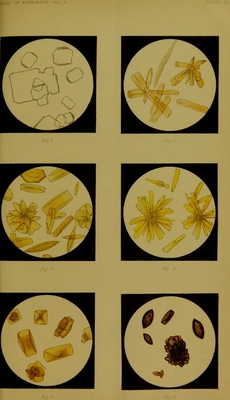
![by indigo blue, by the addition of mineral acid to urines rich in indoxyl sulphate. On the other hand, the indigo pigments cannot be supposed to have any share in the coloration of the naturally deposited crystals, since these pigment are, as far as I am aware, only produced spontaneously in alkaline urines. Conclusions. 1. Of the true urinary pigments, which exist ready formed in urine, only the normal yellow pigment (urochrome) and uroerythrin appear to possess the property of colouring uric acid crystals deposited from their solutions. 2. The yellow pigment, being a constant constituent of the urine, always furnishes the ground tint of the crystals, and plays the more important part in determining their form; the whetstone or canoe shape being that which this substance specially tends to produce. 3. In the majority of instances uric acid crystals, which are spon- taneously and rapidly deposited from urine, contain uroerythrin also, and it is to this pigment that the sediments owe their red colour when seen in bulk. 4. The various shades of orange and red observed in the individual crystals are due to the admixture, in varying relative proportions, of the above two pigments ; and although crystals coloured by the yellow pigment alone are sometimes met with, uroerythrin is never the sole colouring matter of the natural sediments. 5. The minute quantity of iron present in the sediments is not a constituent either of the yellow pigment or of uroerythrin. 6. Other pigments occasionally present in urine, which have a share in the coloration of the crystals in some cases, are the brown products produced by the action of mineral acids, the oxidation products of phenol derivatives, and the pigments of the bile. 7. Urobilin and hpematoporphyrin take no part in the coloration of the crystals. [The expenses of this research were amongst those covered by a grant from the Government Grant Committee of the Eoyal Society.] DESCRIPTION OF PLATE III. Fig. 1.—Crystals of pure, colourless uric acid. Fig. 2.—Crystals of uric acid deposited from a solution of uroerythrin. Pig. 3.—Crystals of uric acid deposited from a solution of the yellow pigment of urine (urochrome), in which some colourless urate had been dissolved. Pig. 4.—Crystals of uric acid deposited from a specimen of urine rich in biliverdin. Pig. 5.—Crystals of uric acid thrown down by the addition of hydrochloric acid to normal urine. Fig. G —Crystals of uric acid deposited from the dark urine of a patient with carboluria.](https://iiif.wellcomecollection.org/image/b22382732_0012.jp2/full/800%2C/0/default.jpg)

 No text description is available for this image
 No text description is available for this image
 No text description is available for this image