Notes on essential oils : with special reference to their use, composition, chemistry, and analysis / by T.H.W. Idris.
- Idris, T. H. W.
- Date:
- [1900?]
Licence: In copyright
Credit: Notes on essential oils : with special reference to their use, composition, chemistry, and analysis / by T.H.W. Idris. Source: Wellcome Collection.
36/256 page 20
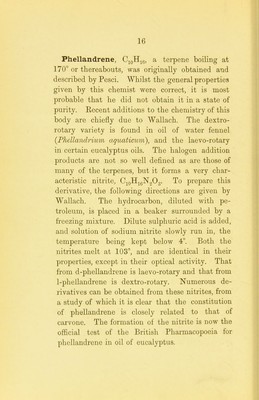
![ethyl alcohol. It then melts at 96°. By heating with dilute acids or P2O5, it gives up a molecule of water and reforms a sesquitei’pene. But a molecular re-arrangement takes place, so that instead of obtaining pure caryophyllene, one obtains Glovene, an isomeric sesquiterpene. Cary- ophyllene nitroso-chloride C;igH24NOCl forms a white powder melting at 161 °-l 6 3°. The nitrosate C45H24N2O4 is formed by the action of amyl nitrite, acetic acid and sulphuric acid. It forms needles melting at 148°. Clovene C45H24 is obtained as described above. It boils at 261°-263°, has a specific gravity of ‘930 at 18° and a refractive index of 1'50066. It does not yield a crystalline alcohol, so that it is clearly not identical with caryophyllene. Cedrene C45H24 occurs in cedar wood oil. It has so far been prepared only by fractional dis- tillation of the oil, unless, indeed, the hydrocarbon obtained by heating cedar camphor (cedrol) with acetic anhydride is identical with it. According to Chapman the boiling point of cedrene is 261°-262°, the specific gravity at 15° is '9359, and the optical activity [a]d = — 60°. According to Kousset, however, its rotation is only — 47'9°. A hydrocarbon of a very similar nature is produced by the action of P2O5 on santalal, the aldehyde of](https://iiif.wellcomecollection.org/image/b28137528_0036.jp2/full/800%2C/0/default.jpg)



 No text description is available for this image
 No text description is available for this image
 No text description is available for this image