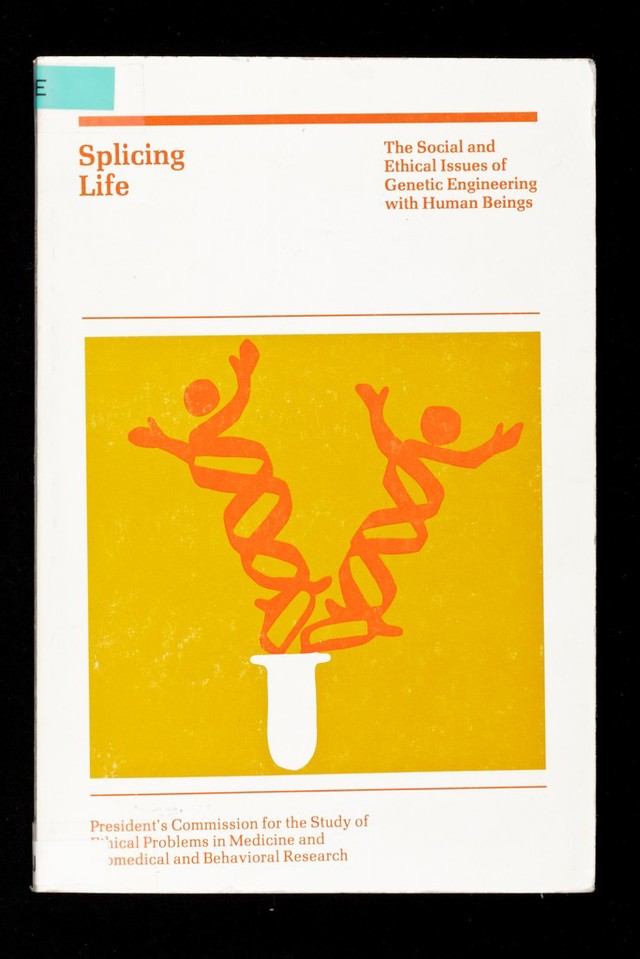
Splicing life : a report on the social and ethical issues of genetic engineering with human beings / President's Commission for the Study of Ethical Problems in Medicine and Biomedical and Behavioral Research.
- President's Commission for the Study of Ethical Problems in Medicine and Biomedical and Behavioral Research
- Date:
- 1982
Licence: Attribution-NonCommercial 4.0 International (CC BY-NC 4.0)
Credit: Splicing life : a report on the social and ethical issues of genetic engineering with human beings / President's Commission for the Study of Ethical Problems in Medicine and Biomedical and Behavioral Research. Source: Wellcome Collection.
23/132 page 11
![Clarifying the Issues 13 opponents now bear the burden of proving danger, rather than the proponents having to prove safety. No physical injuries have been found to have resulted from new organisms created with gene splicing techniques. Most molecular biologists now say they believe that the original worries were exaggerated. Nevertheless, a few scien¬ tists continue to maintain that some questions remain unan¬ swered and that continued caution is desirable. This conserva¬ tive approach influenced RAC enough that the committee decided in early 1982 not to convert the guidelines into a voluntary code of good laboratory practice. Some RAC mem¬ bers also worried that the Federal withdrawal from the field would lead states and localities to adopt varying, and often more onerous, regulations. Deeper Anxieties. While the political, public, and scientific debate has focused on the hazards of pathogenic organisms, it has become apparent that the implications of gene splicing are more far-reaching. The consequences of mistakes or failures in the laboratory have received attention, but success in learning how to manipulate genes could have enormous societal consequences as well. The fact that in the mid-1970s laboratory experiments with recombinant DNA were assumed for a time to be quite risky ought not to mean that forever thereafter any research in gene splicing has to overcome a presumption of danger.Nevertheless, new knowledge does carry a responsi¬ bility—often weighty—for its application, and the implications To suggest that the burden of proof issue lies at the heart of the recombinant DNA debate is not to suggest that it is a single issue or, indeed, that one determination of who bears what burden of going forward with what evidence and persuading whom will be satisfactory for all aspects of public policy regarding recombinant DNA. One ground for suggesting differ¬ ent burdens might be that the risks motivating concern in the first place are of different sorts [i.e., physical versus social risksj. Another way of slicing the conceptual pie is according to the stage of the research process, between the risks of means.. .and the risks of ends. A.M. Capron, Prologue: Why Recombinant DNA?, 51 S. Cal. L. Rev. 973, 977 (1978). Marjorie Sun, Committee Votes to Keep DNA Rules Mandatory, 215 Science 949 (1982]. It is generally true that scientific researchers need not demonstrate the safety of their investigations as a condition of proceeding. But can review be triggered by the expression of genuine concern about risks by knowledgeable parties? In the case of recombinant DNA, do the initial warnings by scientists of possible disasters from research mishaps have continuing force once the same scientists suggest that subsequent experi¬ ence has led them to doubt that any unusual risk exists? In other words, once triggered can a process of decision be called](https://iiif.wellcomecollection.org/image/B18035206_0024.JP2/full/800%2C/0/default.jpg)


 No text description is available for this image
 No text description is available for this image
 No text description is available for this image