Splicing life : a report on the social and ethical issues of genetic engineering with human beings / President's Commission for the Study of Ethical Problems in Medicine and Biomedical and Behavioral Research.
- President's Commission for the Study of Ethical Problems in Medicine and Biomedical and Behavioral Research
- Date:
- 1982
Licence: Attribution-NonCommercial 4.0 International (CC BY-NC 4.0)
Credit: Splicing life : a report on the social and ethical issues of genetic engineering with human beings / President's Commission for the Study of Ethical Problems in Medicine and Biomedical and Behavioral Research. Source: Wellcome Collection.
26/132 page 14
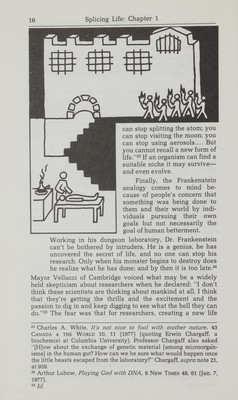
![16 Splicing Life: Chapter 1 m can stop splitting the atom; you can stop visiting the moon; you can stop using aerosols.... But you cannot recall a new form of life.^^ If an organism can find a suitable niche it may survive— and even evolve. Finally, the Frankenstein analogy comes to mind be¬ cause of people's concern that something v^as being done to them and their world by indi¬ viduals pursuing their own goals but not necessarily the goal of human betterment. Working in his dungeon laboratory, Dr. Frankenstein can't be bothered by intruders. He is a genius, he has uncovered the secret of life, and no one can stop his research. Only when his monster begins to destroy does he realize what he has done; and by then it is too late.^^ Mayor Vellucci of Cambridge voiced what may be a widely held skepticism about researchers when he declared: I don't think these scientists are thinking about mankind at all. I think that they're getting the thrills and the excitement and the passion to dig in and keep digging to see what the hell they can do.^® The fear was that for researchers, creating a new life Charles A. White, It's not nice to fool with mother nature, 43 Canada & the World 10, 11 (1977) (quoting Erwin Chargaff, a biochemist at Columbia University). Professor Chargaff also asked [H]ow about the exchange of genetic material [among microorga'n- isms] in the human gut? How can we be sure what would happen once the little beasts escaped from the laboratory? Chargaff, supra note 21, at 939. Arthur Lubow, Playing God with DNA, 8 New Times 48, 61 (Jan. 7, 1977). ^4d.](https://iiif.wellcomecollection.org/image/B18035206_0027.JP2/full/800%2C/0/default.jpg)




 No text description is available for this image
 No text description is available for this image
 No text description is available for this image