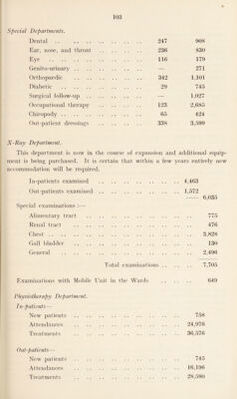
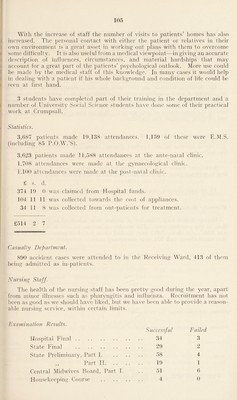
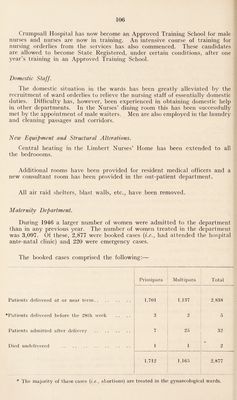
[Report 1946] / Medical Officer of Health, Manchester City.
- Manchester (England). City Council. n 88637066.
- Date:
- 1946
Licence: Attribution 4.0 International (CC BY 4.0)
Credit: [Report 1946] / Medical Officer of Health, Manchester City. Source: Wellcome Collection.
110/248 page 104
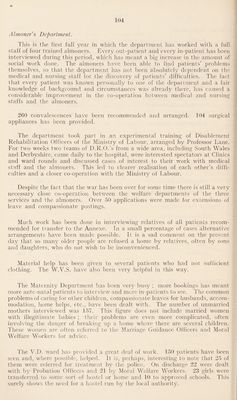
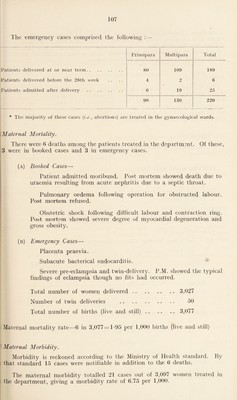
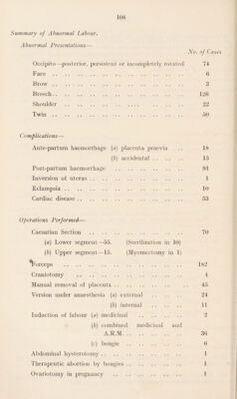
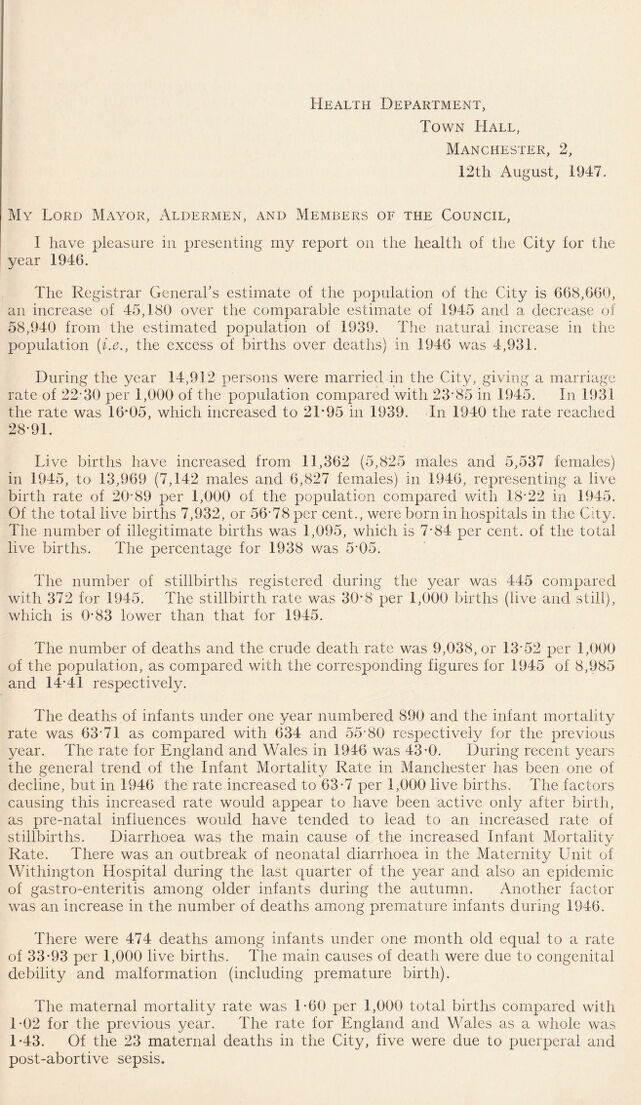
![Almoner’s Department. This is the first full year in which the department has worked with a full staff of four trained almoners. Every out-patient and every in-patient has been interviewed during this period, which has meant a big increase in the amount of social work done. The almoners have been able to find patients’ problems themselves, so that the department has not been absolutely dependent on the medical and nursing staff for the discovery of patients’ difficulties. The fact that every patient was known personally to one of the department and a fair knowledge of background and circumstances was already there, has caused a considerable improvement in the co-operation between medical and nursing staffs and the almoners. 260 convalescences have been recommended and arranged. 104 surgical appliances has been provided. The department took part in an experimental training of Disablement Rehabilitation Officers of the Ministry of Labour, arranged by Professor Lane. For two weeks two teams of D.R.O.’s from a wide area, including South Wales and Derbyshire, came daily to the hospital, were interested spectators at Clinics and ward rounds and discussed cases of interest to their work with medical staff and the almoners. This led to clearer realisation of each other’s diffi¬ culties and a closer co-operation with the Ministry of Labour. Despite the fact that the war has been over for some time there is still a very necessary close co-operation between the welfare departments of the three services and the almoners. Over 50 applications were made for extensions of leave and compassionate postings. Much work has been done in interviewing relatives of all patients recom¬ mended for transfer to the Annexe. In a small percentage of cases alternative arrangements have been made possible. It is a sad comment on the present day that so man}/ older people are refused a home by relatives, often by sons and daughters, who do not wish to be inconvenienced. Materia] help has been given to several patients who had not sufficient clothing. The W.V.S. have also been very helpful in this way. The Maternity Department has been very busy ; more bookings has meant more ante-natal patients to interview and more in-patients to see. The common problems of caring for other children, compassionate leaves for husbands, accom¬ modation, home helps, etc., have been dealt with. The number of unmarried mothers interviewed was 157. This figure does not include married women with illegitimate babies ; their problems are even more complicated, often involving the danger of breaking up a home where there are several children. These women are often referred to the Marriage Guidance Officers and Moral Welfare Workers for advice. The V.D. ward has provided a great deal of work. 150 patients have been seen and, where possible, helped. It is, perhaps, interesting to note that 25 of them were referred for treatment by the police. On discharge 22 were dealt with by Probation Officers and 21 by Moral Welfare Workers. 23 girls were transferred to some sort of hostel or home and 10 to approved schools, This surely shows the need for a hostel run by the local authority.](https://iiif.wellcomecollection.org/image/b29785674_0110.jp2/full/800%2C/0/default.jpg)