Handbook of the British flora : a description of the flowering plants and ferns indigenous to, or naturalised in, the British Isles / [George Bentham].
- George Bentham
- Date:
- 1912
Licence: In copyright
Credit: Handbook of the British flora : a description of the flowering plants and ferns indigenous to, or naturalised in, the British Isles / [George Bentham]. Source: Wellcome Collection.
110/672 page 26
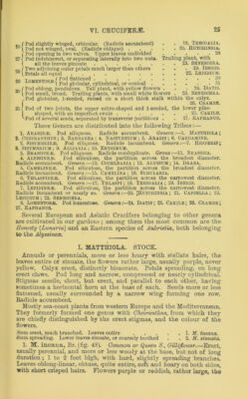
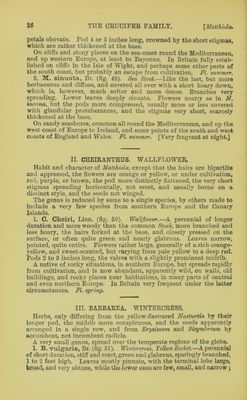
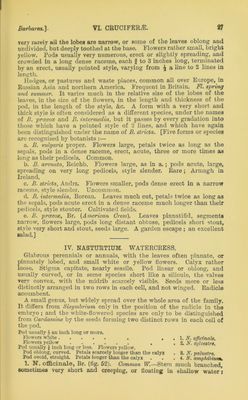
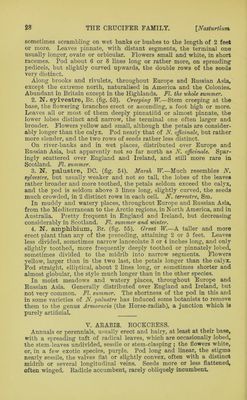
![petals obovate. Pod 4 or 5 inches long, crowned by the short stigmas, which are rather thickened at the base. On cliffs and stony places on the sea-coast round the Mediterranean, a-nd up western Europe, at least to Bayonne. In Britain fully estab- lished on cliffs in the Isle of Wight, and perhaps some other parts of the south coast, but probably an escape from cultivation. FI. summer. 2. M. sinuata, Br. (fig. 49). Sea Stock.—Like the last, but more herbaceous and diffuse, and covered all over with a short hoary down, which is, however, much softer and more dense. Branches very spreading. Lower leaves deeply sinuate. Flowers nearly as in M. incana, but the pods more compressed, usually more or less covered with glandular protuberances, and the stigmas very short, scarcely thickened at the base. On sandy seashores, common all round the Mediterranean, and up the west coast of Europe to Ireland, and some points of the south and west coasts of England and Wales. FI. summer. [Very fragrant at night.] II. CHEIRANTHUS. WALLFLOWER Habit and character of Matthiola, except that the hairs are bipartite and appressed, the flowers are orange or yellow, or under cultivation, red, purple, or brown, the pod more distinctly flattened, the very short stigmas spreading horizontally, not erect, and usually borne on a distinct style, and the seeds not winged. The genus is reduced by some to a single species, by others made to include a very few species from southern Europe and the Canary Islands. 1. C. Cheiri, Linn. (fig. 50). Wallflower.—A perennial of longer duration and more woody than the common Stock, more branched and less hoary, the hairs forked at the base, and closely pressed on the surface, or often quite green and nearly glabrous. Leaves narrow, pointed, quite entire. Flowers rather large, generally of a rich orange- yellow, and sweet-scented, but \’urying from pale yellow to a deep red. Pods 2 to 3 inches long, the valves with a slightly prominent midrib. A native of rocky situations, in southern Europe, but spreads rapidly from cultivation, and is now abundant, apparently wild, on walls, old buildings, and rocky places near habitations, in many parts of central and even northern Europe. In Britain very frequent under the latter circumstances. FI. spring. III. BARBAREA. WINTERCRESS. Herbs, only differing from the yellow-flavoured Nasturtia by their longer pod, the midrib more conspicuous, and the seeds apparently arranged in a single row, and from Erysimum and Sisymbrium by accumbent, not incumbent radicle. A very small genus, spread over the temperate regions of the globe. 1. B. vulgaris, Br. (fig. 51). Wintercress, Yellow Rocket.—A perennial of short duration, stiff and erect, green and glabrous, sparingly branched, 1 to 2 feet high. Leaves mostly pinnate, with the terminal lobe large, broad, and very obtuse, while the lower ones are few, small, and narrow ;](https://iiif.wellcomecollection.org/image/b28104754_0110.jp2/full/800%2C/0/default.jpg)
 No text description is available for this image
 No text description is available for this image
 No text description is available for this image