Handbook of the British flora : a description of the flowering plants and ferns indigenous to, or naturalised in, the British Isles / [George Bentham].
- George Bentham
- Date:
- 1912
Licence: In copyright
Credit: Handbook of the British flora : a description of the flowering plants and ferns indigenous to, or naturalised in, the British Isles / [George Bentham]. Source: Wellcome Collection.
114/672 page 30
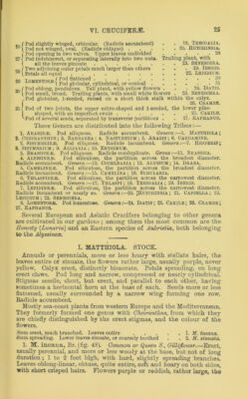
![nstially simple, and rough with short hairs. Radical leaves spreading, obovate or oblong, slightly toothed; stem-leaves generally erect, oblong, or lanceolate, entire or nearly so, all, or at least the upper ones, clasping the stem by short auricles. Flowers small and white. Pods slender, 1 to 2 inches long, erect and crowded in a long raceme. Seeds without any wing. A. sagittata, DC., Turritis hirsuta, Linn. On walls, banks, and rocks, common in the greater part of Europe and Russian Asia, but not in high northern latitudes. Not an abundant plant in Britain, although occurring in numerous localities, even in the north of Scotland. FI. summer [Var, glabrata, Syme, has nearly glabrou.s leaves.] 4. [A. alpina, Linn. (fig. 59). Alpine R.—Very near A. hirsuta, but less stiff ; stem-leaves coarsely toothed, flowers larger and fruiting racemes shorter, with more spreading pods. A native of the Alps and Arctic regions of Europe, Asia, and North America, lately discovered by Mr. H. C. Hart on the Cuchullin mountains in Skye.] 5. A. ciliata, Br. (fig. 60). Fringed R.—Very near A. hirsuta, but not above 6 inches high ; the stem usually glabrous, and the leaves only fringed with a few stiff hairs on their edge, the upper ones rounded at the base and not auricled. The flowers are rather larger, and the pods less erect. In stony and rocky places, in the mountains of central Europe. In Britain only at a few stations in S. Wales and the west coast of Ireland, FI. summer. There is some doubt whether the British and the Continental plants are the same, but probably both are mere varieties of the common A. hirsuta. 6. A. Thaliana, Linn. (fig. 61), Thole R., Thalecrcss, WaUcress.—A slender, erect, branching annual, usually about 6 inches high, but sometimes attaining a foot, clothed with short, spreading stifl' hairs, or sometimes nearly glabrous. Leaves mostly radical and spreading, oblong, with a few coarse teeth, from ^ to 1 inch long. Stem-leaves few, small, and sessile. Flowers small and white. Pods on spreading pedicles, in slender racemes, narrow linear, varying from 4 to 5 inches long to twice that length. Seeds small, the two rows blended into one; the cotyledons placed obliquely, so that the radicle is almost incumbent on the back of one of them. Sisymbrium Thaliana, Hook. On old walls, dry banks, and stony waste places throughout Europe and Russian A.«ia, extending into northern America. Frequent in Britain. FI. early spring, and occasionally also in summer and autumn. On account of the position of the radicle this species is referred by some to Sisymbrium, with which it has little else in common. 7. A. stricta, Huds. (fig. 62). Bi'istol Rockcress.—A perennial, but probably of few years’ duration, resembling in some respects the A. petra:a. Radical leaves in a small spreading tuft, pinnately lobed, and hispid with stiff hairs. Stems about 6 inches high, erect, nearly simple, with a very few small leaves narrowed at the base. Petals narrow and erect. Pods erect, about an inch long. The Continental distribution of this species is uncertain, as the name is often given to plants quite different from ours ; but it appears to be a native of limestone rocks in the mountains of western Europe. In Britain only on St. Vincent’s rocks, near Bristol, where it is becoming](https://iiif.wellcomecollection.org/image/b28104754_0114.jp2/full/800%2C/0/default.jpg)
 No text description is available for this image
 No text description is available for this image
 No text description is available for this image