Handbook of the British flora : a description of the flowering plants and ferns indigenous to, or naturalised in, the British Isles / [George Bentham].
- George Bentham
- Date:
- 1912
Licence: In copyright
Credit: Handbook of the British flora : a description of the flowering plants and ferns indigenous to, or naturalised in, the British Isles / [George Bentham]. Source: Wellcome Collection.
92/672 page 8
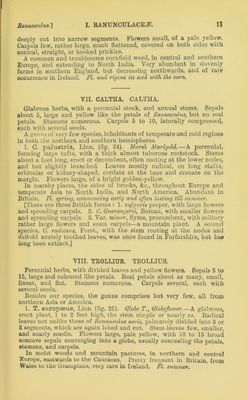
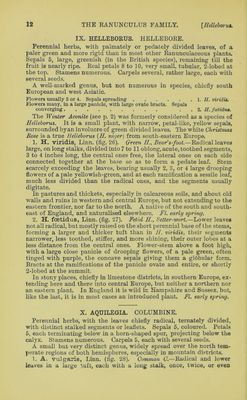
![Britain. IL ccenotus is a floating variety with much larger flowers, rare in Britain, but more common in western Europe, where forms occur also connecting R. hederaceus with R. aquatUia. R. tripartitus is a form with 3-lobed or partite leaves and longer narrow 3-nerved petals [and Lenormandi is another with reniform or orbicular leaves and longer 6- nerved petals]. 3. R. Lingua, Linn. (fig. 11). Great Spearwort.—Rootstock emit- ting a dense mass of fibrous roots, and perennial by means of creeping runners. Stems erect, stout, and hollow, 2 or 3 feet high, the lower nodes emitting whorls of fibrous roots. Leaves long, lanceolate, entire or with a few small teeth, glabrous, with a few nearly parallel veins. Flowers above an inch in diameter, in a kind of loose panicle, bright shining yellow. Carpels ending in a short broad flat beak. In marshes, wet ditches, and edges of lakes, in Europe and temperate Asia, but not Arctic. Found, but not common, in England, Ireland, and Scotland, as far north as Moray. PL summer. 4. R. Flammula, Linn. (fig. 12). Lesser Spearwort.—A glabrous annual, or a perennial, much smaller and more slender than R. Lingua, Stems usually rooting and decumbent at the base, seldom above a foo< high, with a few loose branches. Lowest leaves often ovate, the remainder lanceolate or linear, and all entire or slightly toothed Flowers yellow, on long peduncles, seldom more than half an inch in diameter, and often much smaller. Carpels in a small globular head, each with a very short, usually hooked beak. In marshes and wet pastures, and on the borders of lakes and ponds, common throughout Europe, except perhaps the southern extremity North Asia, and North America. Abundant in Britain. FI. the whoU summer. It varies much in the size of its parts ; the breadth of th« leaves, &c. R. reptans, Linn., is a very slender creeping form or species, with arching internodes, minute achenes and recurved styles, found only on the sandy shores of Loch Leven in Britain. 6. R. ophioglossifolius, Vill. (fig. 13). Snakelongue R.—VerJ nearly allied to R. Plammula, but always annual. The stem is more erect and branched, the lower leaves broadly ovate, and sometimes slightly cordate, and all broader in proportion than in R. Plammula, and the flowers smaller, the petals scarcely exceeding the calyx. Carpels minutely granulated. In marshes in South and West Europe. Hampshire only in Britain, and formerly St. Peter’s Marsh in Jersey, where it is extinct. FI. Jwne. 6. R. Ficaria, Linn. (fig. 14). Figwort R., Lesser Celandine.— Rootstock small, emitting oblong or cylindric^ tubers, which are renewed annually. Leaves mostly radical, cordate, obtuse, angular or crenate, thick, smooth, and shining. Flower-stems usually scarcely longer than the root-leaves, bearing one or two small leaves and a single flower, with 3 sepals and 8 or 9 oblong glossy yellow petals. Carpels rather large, in a globular head. In fields, pastures, and waste places, a very common weed through- out Europe and western Asia. Abundant in Britain, except perhaps ®he west Highlands of Scotland. FI. spring, one of the earliest that xppears. It varies occasionally with a slightly branched, creeping stem of 8 or 9 inches or even more, with most of the leaves op/posite. 7. R. sceleratus, Linn. (fig. 15). Celery-leaved R.—An erect, much](https://iiif.wellcomecollection.org/image/b28104754_0092.jp2/full/800%2C/0/default.jpg)
 No text description is available for this image
 No text description is available for this image
 No text description is available for this image