Handbook of the British flora : a description of the flowering plants and ferns indigenous to, or naturalised in, the British Isles / [George Bentham].
- George Bentham
- Date:
- 1912
Licence: In copyright
Credit: Handbook of the British flora : a description of the flowering plants and ferns indigenous to, or naturalised in, the British Isles / [George Bentham]. Source: Wellcome Collection.
94/672 page 10
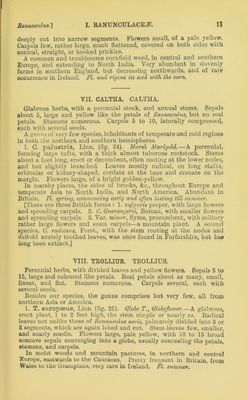
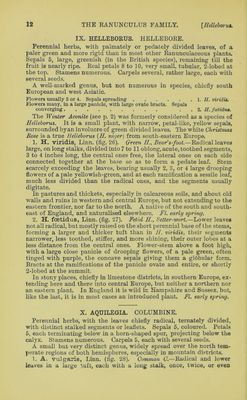
![11. B». flabellatus, Desf. (fig. 19). Fine-leaved R.—A hairy peren- nial, with the habit of the smaller specimens of R. hulboam. Stem usually 6 to 9 inches high, thickened at the base into a kind of bulb, covered with the fibrous remains of old leaves, and emitting small tubers from the base amongst the fibrous roots. Leaves radical, the early outer ones often rounded and toothed only, the more permanent ones once or twice ternately divided into cut segments. Flowers few, rather large, bright yellow, the sepals spreading, but not reflected. Carpels numerous, glabrous, collected in an oblong or cylindrical head. R. ChcerophyUofi, Linn., of former editions. In rather dry, waste, and cultivated places, and hilly pastures, especially in western and southern Europe, and formerly occurring near St. Aubin’s, in Jersey. FI. early summer. 12. R. bulbosus, Linn. (fig. 20). Ftdbous R,—A perennial, much smaller and usually more hairy than the R. acris, of which it has the bright yellow petals. Stem seldom above a foot high, and usually thickened at the base into a kind of bulb. Leaves more like those of R. repcns, but smaller, divided into 3 segments more or less cut, but broader than in R. acris. It is distinguished from all but R. hirsutus by the sepals, which, as soon as the flower expands, are closely re- flected on the peduncle. Carpels glabrous and smooth, in a globular head. In meadows, pastures, and waste places over the greater part of Europe, but disappearing in the north-east, rare in western Asia ; naturalised in North America. Abundant in Britain. FI. early summer. 13. R. hirsutus, Curtis, (fig. 21). Hairy li.—An erect annual, much branched from the base, 6 inches to near a foot high, with the foliage and reflexed calyx of R. bulbosus, but the flowers more numerous, rather smaller, and of a paler yellow, and the hairs of the stem usually fewer and looser, although in this respect both species are variable. Carpels with a series of tubercles (visible especially when dry) within the rather broad margin. In flelds, cultivated and waste places, in central and southern Europe, extending eastward to the Caucasus, and northward to southern Sweden. In most parts of England and southern Scotland, but not generally common, and unknown in Ireland. FI. summer. [iZ. Philonctia, Ehr., the name adopted in earlier editions of this work, is of later date than hirsutus. R. Sardous, Crantz, &ndparvulus, Linn., are earlier than either, but are quite misleading.] 14. R. parviflorus, Linn. (fig. 22). Small-flowered R.—A hairy annual, with weak, prostrate or ascending stems, from a few inches to about a foot in length. Leaves nearly orbicular, the lower ones 6-lobed or crenate, the upper ones divided into 3 or 5 segments, which are more or less lobed, but generally less so than in R. hirsutus. Peduncles short, mostly opposite to the leaves. Flowers small and yellow, the petals narrow, seldom exceeding the calyx. Carpels covered with small tubercles. In cultivated and waste places in Europe and Asia; introduced into N. America. Not common in Britain, although occurring here and there in England and Ireland ; not in Scotland. FI. spring and summer. 15. R. arvensis, Linn. (fig. 23). Com R.—An erect, branching oearly glabrous annual, of a pale green, 6 to 18 inches high. Leaves](https://iiif.wellcomecollection.org/image/b28104754_0094.jp2/full/800%2C/0/default.jpg)
 No text description is available for this image
 No text description is available for this image
 No text description is available for this image