Specification of Pierre Louis Thimoté Thiers : instrument for the drawing off milk from the breasts of women, &c.
- Thiers, Pierre Louis Thimoté.
- Date:
- 1857
Licence: Public Domain Mark
Credit: Specification of Pierre Louis Thimoté Thiers : instrument for the drawing off milk from the breasts of women, &c. Source: Wellcome Collection.
4/10 page 2
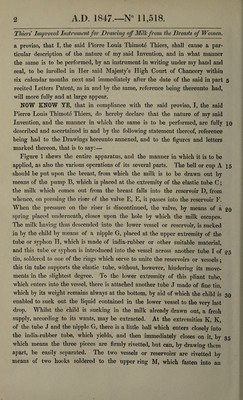
![Thiers Improved Instrument for Drawing off Milk from the Dreasts of Women. a proviso, that I, the said Pierre Louis Thiraote Thiers, shall cause a par¬ ticular description of the nature of my said Invention, and in what manner the same is to be performed, by an instrument in writing under my hand and seal, to be inrolled in Her said Majesty’s High Court of Chancery within six calendar months next and immediately after the date of the said in part 5 recited Letters Patent, as in and by the same, reference being thereunto had, will more fully and at large appear. NOW KNOW YE, that in compliance with the said proviso, I, the said Pierre Louis Thimote Thiers, do hereby declare that the nature of my said Invention, and the manner in which the same is to be performed, are fully 10 described and ascertained in and by the following statement thereof, reference being had to the Drawings hereunto annexed, and to the figures and letters marked thereon, that is to say:— Figure 1 shews the entire apparatus, and the manner in which it is to be applied, as also the various operations of its several parts. The bell or cup A ] 5 should be put upon the breast, from which the milk is to be drawn out by means of the pump B, which is placed at the extremity of the elastic tube C; the milk which comes out from the breast falls into the reservoir D, from whence, on pressing the riser of the valve E, E, it passes into the reservoir F. When the pressure on the riser is discontinued, the valve, by means of a go spring placed underneath, closes upon the hole by which the milk escapes. The milk having thus descended into the lower vessel or reservoir, is sucked in by the child by means of a nipple G, placed at the upper extremity of the tube or syphon H, which is made of india-rubber or other suitable material, and this tube or syphon is introduced into the vessel across another tube I of 25 tin, soldered to one of the rings which serve to unite the reservoirs or vessels; this tin tube supports the elastic tube, without, however, hindering its move¬ ments in the slightest degree. To the lower extremity of this pliant tube, which enters into the vessel, there is attached another tube J made of fine tin, which by its weight remains always at the bottom, by aid of which the child is 30 enabled to suck out the liquid contained in the lower vessel to the very last drop. Whilst the child is sucking in the milk already drawn out, a fresh supply, according to its wants, may be extracted. At the extremities K, K, of the tube J and the nipple G, there is a little ball which enters closely into the india-rubber tube, which yields, and then immediately closes on it, by 35 which means the three pieces are firmly rivetted, but can, by drawing them apart, be easily separated. The two vessels or reservoirs are rivetted by means of two hooks soldered to the upper ring M, which fasten into an](https://iiif.wellcomecollection.org/image/b3074555x_0004.jp2/full/800%2C/0/default.jpg)