Volume 1
A glossary of terms used in Grecian, Roman, Italian, and Gothic architecture / [Anon].
- John Henry Parker
- Date:
- 1840
Licence: Public Domain Mark
Credit: A glossary of terms used in Grecian, Roman, Italian, and Gothic architecture / [Anon]. Source: Wellcome Collection.
18/300 page 6
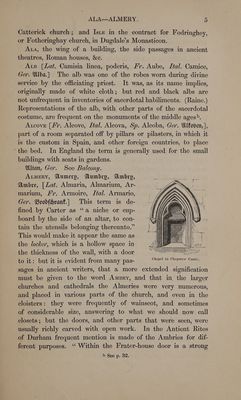
![Ambrie in the stone wall, where a great Mazer, called the grace-cup, did stand, which did service to the monks every day, after grace was said, to drink in round the table. “In that almery lay all the plate that served the whole convent in the Frater-house on festival days; and there was a fine work of carved wainscot before it, and a strong lock on the door, so that none could perceive there was any almery at all, the key- hole being made under the carved work of the wainscot.” Atmonry, Atmonarium, [#’r. Aumonerie, Ital. Ufficio di ele- mosiniere, Ger. Wimofenamt,], a room where alms were distri- buted: in monastic establishments it was generally a stone building near the church, on the north side of the quadrangle, or sometimes removed to the gate-house. Arar, Auter, Awter, (Lat. Altare, Altarium, Fr. Autel, Sial. Altare, Ger. Wtar,], an elevated table, dedicated to particular ceremonies of religious worship‘: they were generally of wood during the first four or five centuries of the Christian era, but the Council of Epone in France, A. D. 509, commanded that they should be of stone, and this custom gradually prevailed until the Reformation‘. In the early ages of the Christian era there was but one altar in any church, but in later times there were frequently many others besides the high altar, especially at the east end® of the aisles, each dedicated to a particular saint, as is still the custom on the continent: but high mass is celebrated at the high altar only. The other altars are used for the per- formance of low mass, or private masses for the souls of bene- e Altar is a term also applied to a small portable tablet serving for the consecra- tion of the elements, when required to be consecrated away from a proper altar in a church or chapel. It was called ““superaltare,” and “upper altar,” and was in fact a portable altar, which might be used on all occasions and in all places where it was required. One of silver was buried in the coffin with St. Cuthbert. d See Bingham’s Antiquities, book viii. c. 6 and 15. e There are instances of the chief altar not being at the east end, as at the church in the castle at Caen, which has the entrance at the east end. An altar at the west as well as the east is more frequent : this is the case at Nevers cathe- dral, and in two churches at Falaise. Many old churehes are built far from truly to the points of the compass, as at Caen and other places. In the Basilica of Constantine, or Church of the Holy Cross, attached to the Holy Sepulchre at Jerusalem, the entrance was at the east end, and the altar near the west end, with the bishop’s throne behind it, at the extremity of the apse; the ambo being placed on the south side, about half way between the east end and the altar. (See the ground- plan of this church‘in Mr. Newman’s preface to St. Cyril.) The present church of the Holy Sepulchre at Jerusalem was built by the Normans about the year 1200.](https://iiif.wellcomecollection.org/image/b29333775_0001_0018.jp2/full/800%2C/0/default.jpg)
 No text description is available for this image
 No text description is available for this image
 No text description is available for this image