Volume 1
A glossary of terms used in Grecian, Roman, Italian, and Gothic architecture / [Anon].
- John Henry Parker
- Date:
- 1840
Licence: Public Domain Mark
Credit: A glossary of terms used in Grecian, Roman, Italian, and Gothic architecture / [Anon]. Source: Wellcome Collection.
26/300 page 14
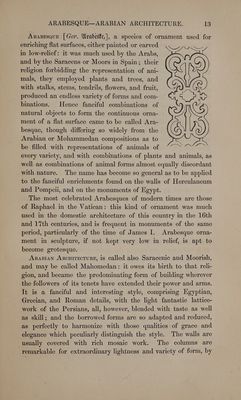
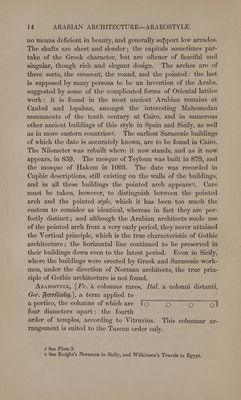
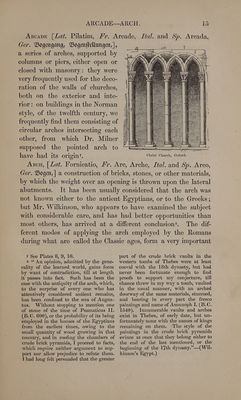
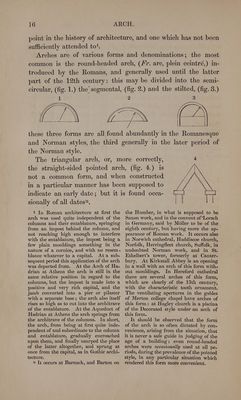
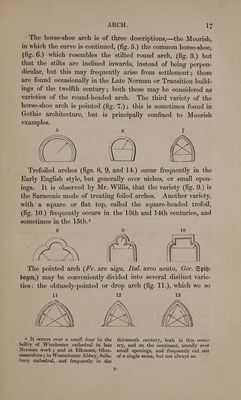
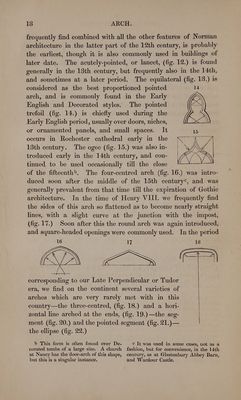
![no means deficient in beauty, and generally support low arcades. The shafts are short and slender; the capitals sometimes par- take of the Greek character, but are oftener of fanciful and singular, though rich and elegant design. The arches are of three sorts, the crescent, the round, and the pointed: the last is supposed by many persons to be an invention of the Arabs, suggested by some of the complicated forms of Oriental lattice work: it is found in the most ancient Arabian remains at Caubul and Ispahan, amongst the interesting Mahomedan monuments of the tenth century at Cairo, and in numerous other ancient buildings of this style in Spain and Sicily, as well as in more eastern countriesP. The earliest Saracenic buildings of which the date is accurately known, are to be found in Cairo. The Nilometer was rebuilt where it now stands, and as it now appears, in 859. The mosque of Teyloun was built in 879, and the mosque of Hakem in 1003. The date was recorded in Cuphic descriptions, still existing on the walls of the buildings, and in all these buildings the pointed arch appears4. Care must be taken, however, to distinguish between the pointed arch and the pointed style, which it has been too much the custom to consider as identical, whereas in fact they are per- fectly distinct ; and although the Arabian architects made use of the pointed arch from a very early period, they never attained the Vertical principle, which is the true characteristic of Gothic architecture ; the horizontal line continued to be preserved in their buildings down even to the latest period. Even in Sicily, where the buildings were erected by Greek and Saracenie work- men, under the direction of Norman architects, the true prin- ciple of Gothic architecture is not found. AraxostyLE, [#7. a colonnes rares, Jtal. a colonni distanti, Ger. Fernfaulig,], a term applied to a portico, the columns of which are [TO =O © ol four diameters apart: the fourth order of temples, according to Vitruvius. This columnar ar- rangement is suited to the Tuscan order only. p See Plate 3. qd See Knight’s Normans in Sicily, and Wilkinson’s Travels in Egypt.](https://iiif.wellcomecollection.org/image/b29333775_0001_0026.jp2/full/800%2C/0/default.jpg)
 No text description is available for this image
 No text description is available for this image
 No text description is available for this image