Interim report of Departmental Committee on Maternal Mortality & Morbidity.
- Great Britain. Committee on Maternal Mortality & Morbidity.
- Date:
- 1930
Licence: Public Domain Mark
Credit: Interim report of Departmental Committee on Maternal Mortality & Morbidity. Source: Wellcome Collection.
30/156 (page 28)
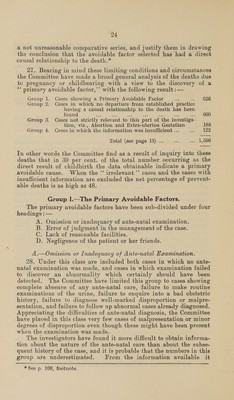
![In nearly one-third of the cases classed as errors of judgment on the part of the doctor, the mistake was premature application of the forceps. In many of these delivery was not effected, and the patient was ultimately sent to hospital where incomplete dilatation of the cervix or disproportion was usually found to be present. Other examples of common error are failure to treat a toxaemia of preg- nancy, and the neglect of early warning haemorrhage in placenta praevia. | 36. Error of judgment on the part of the doctor or midwife or hospital was assigned as the primary avoidable factor leading up to the death of the patient in 224 cases (85°7 per cent. of the group of 626 cases), and these cases are analysed in the following table :— TABLE C. Errors of Judgment. _ Doctor. Hosp. Midwife. Total. i. Treatment of severe toxaemias of preg- nancy faulty or absent ee at 27 9 t 43 2. Neglect of warning haemorrhages ... 17 2 5 24 3. Improper use of forceps és #43 4] 4 oo 45 4. Faulty treatment of third stage of labour ... oe a kee ie 16 2 9 27 5. Non-recognition of obstructed labour 8 2 10 20 6. Gross errors in the prevention or re- ! cognition of sepsis ... iva ath 7 2 14 23 Z. Miscellaneous _... ey si fas 30 — 12 42 otal). 3,2 tA 21 57 224 C. Lack of Reasonable Facilities. 37. In this class are included cases in which the absence of skilled assistance was the primary cause in the death, cases conducted in abnormal surroundings such as delivery in a cowshed, instances of women living in remote and isolated situations and ene or two examples of extreme overcrowding. Poverty and uncleanliness, although unfortunate accessory factors, have not, so far as can be ascertained from the reports, borne any direct relation to these deaths. Lack of reasonable facilities was considered to be the primary avoidable factor in 64 cases. From an examination of the returns, it appeared that only a few of the deaths could be attributed to difficulty in obtaining medical assistance of some sort. In 26 cases it was thought that the most important factor leading to the fatal issue was absence of a second doctor to give an anaesthetic. In 13 eases 1t seemed probable that if the doctor had had a trained assistant, instead of having to rely in a difficulty upon the inadequate help of a totally incompetent relative or friend, the result would have been different. In 25 deaths it was considered that the most important cause leading up to the death lay in the bad surroundings under which the patient was confined. Absence of hospital beds and of consultant services had undoubt- edly been responsible for death in many cases, but the Committee have found it impossible to express this numerically. They are](https://iiif.wellcomecollection.org/image/b32173416_0030.jp2/full/800%2C/0/default.jpg)