The complement fixation test in syphilis, commonly known as the Wassermann test.
- Great Britain. Ministry of Health
- Date:
- 1920
Licence: Public Domain Mark
Credit: The complement fixation test in syphilis, commonly known as the Wassermann test. Source: Wellcome Collection.
185/218 page 181
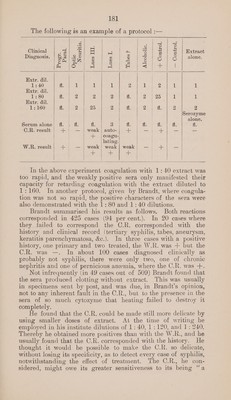
![18] | The following 1s an example of a protocol : oe a are rah ceiab ius Clinical 3 a es ms a. ; = ‘ | Extract Diagnosis. 3 é - eae 2 3 3 S | & | alone. = Ry S ics) 3 es C4 ) I ped ca <q a | Extr. dil. | 1:40 il: 1 it 1 2 eyes, Sie 1 1 Extr. dil. | 1:80 fl 2 2 fl VADs a 1 Extr. dil. | | 1:160 fl. 2 25 2 | fl 2 fl 2 2 | | Serozyme | alone. Serum alone) fl. | fi. fl. of ji ae” Fi fi. fl. fi. C.R. result = — | weak | auto- | + ely ee = == | + | coagu-, | | lating. | W.R. result | + > — | weak! weak| weak) — ee oo | rer eee ee | in the above experiment coagulation with 1:40 extract was too rapid, and the weakly positive sera only manifested their capacity for retarding coagulation with the extract diluted to 1:160. In another protocol, given by Brandt, where coagula- tion was not so rapid, the positive characters of the sera were also demonstrated with the 1:80 and 1: 40 dilutions. Brandt summarised his results as follows. Both reactions corresponded in 425 cases (94 per cent.). In 20 cases where they failed to correspond the O.R. corresponded with the history and clinical record (tertiary syphilis, tabes, aneurysm, keratitis parenchymatosa, &c.). In three cases with a positive history, one primary and two treated, tlhe W.R. was + but the C.R. was —. In about 100 cases diagnosed clinically as probably not syphilis, there were only two, one of chronic nephritis and one of pernicious anzemia, where the C.R. was +-. Not infrequently (in 49 cases out of 509) Brandt found that the sera produced clotting without extract. This was usually in specimens sent by post, and was due, in Brandt’s opinion, not to any inherent fault in the C.R., but to the presence in the sera of so much cytozyme that heating failed to destroy it completely. He found that the C.R. could be made still more delicate by using smaller doses of extract. At the time of writing he employed in his institute dilutions of 1: 40, 1: 120, and 1: 240, Thereby he obtained more positives than with the W.R., and he usually found that the C.R. corresponded with the history. He thought it would be possible to make the CU.R. so delicate, without losing its specificity, as to detect every case of syphilis, notwithstanding the effect of treatment. The C.R., he con- 66 sidered, might owe its greater sensitiveness to its being “a](https://iiif.wellcomecollection.org/image/b32183604_0185.jp2/full/800%2C/0/default.jpg)

 No text description is available for this image
 No text description is available for this image
 No text description is available for this image