The complement fixation test in syphilis, commonly known as the Wassermann test.
- Great Britain. Ministry of Health
- Date:
- 1920
Licence: Public Domain Mark
Credit: The complement fixation test in syphilis, commonly known as the Wassermann test. Source: Wellcome Collection.
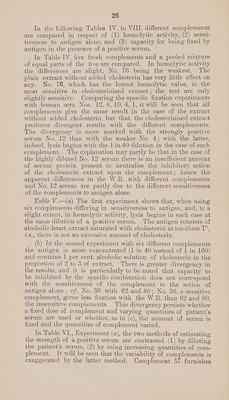
25/218 page 21
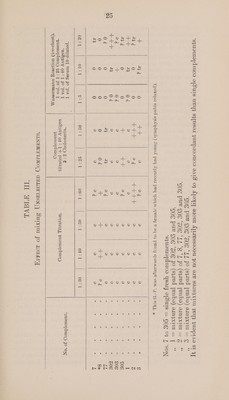
![COMPLEMENT. (1) Source. —Guinea-pig complement has been used exclusively in our experiments. The blood was placed imme- diately in the incubator at 37° C. for half-an-hour, after which the clot was usually found retracted and the serum ready to be pipetted off. (2) Variability of Complement.—Of all the reagents in the W.R., complement is the least capable of standardisation, and it 1s certainly the reagent which is most often responsible for discrepancies in the results on different occasions. It has been suggested that by pooling the sera from a number of guinea- pigs a complement of average character might be obtained. This is probably true so far as the hemolytic activity is concerned, but it is not the case as regards the behaviour in the Wassermann reaction, see Table III. (p. 25). It will be observed, for example, that the readings for the W.R. with the 1 in 20 dilution of the syphilitic serum vary with the different mixtures of complement from +-+ lysis to ? trace lysis: the range of variation is not much less than that shown by the individual complements. Variations in hemolytic activity in the sera of well-fed guinea-pigs are of less frequent occurrence, and are of less importance in the test, than variations in the degree to which the complement is inhibited in the presence of antigen alone or, still more important, in presence of the mixture of antigen and human serum. It is necessary, therefore, to study the differences of this character between the complements of different guinea-pigs and to form an opinion as to their influence on the result of the W.R. For this purpose repeated observations on the same guinea-pig are more valuable than single examinations. The following data-have been obtained by the study of 60 guinea- pigs from which blood was removed at successive intervals. (a) Varzations in Hemolytic Activity.—Healthy male guinea- pigs, with few exceptions, furnish complement which varies in hemolytic activity only within well-defined and narrow limits. The minimum concentration of complement necessary for com- plete lysis in our experiments has lain between 1 in 240 and 1 in 160, and has most commonly been 1 in 200. The latter figure is obtained thus: one volume (0°25 ¢.c.) of a 1 in 50 dilution of complement is added to two volumes (0°5 c.c.) of salt solution and one volume (V0°25 e.c.) of a 3 per cent. suspension of fully sensitised sheep’s cells (z.¢e., 1 in 50 complement diluted 1 in 4 =] in 200). Any complement which requires a greater concentration than 1 in 125 to effect complete lysis under the above conditions should not be employed. The conditions which we propose for the actual W.R. involve keeping the complement diluted in the ice-chest overnight before](https://iiif.wellcomecollection.org/image/b32183604_0025.jp2/full/800%2C/0/default.jpg)