Licence: Public Domain Mark
Credit: Outlines of zoology / by J. Arthur Thomson. Source: Wellcome Collection.
Provider: This material has been provided by the Royal College of Physicians of Edinburgh. The original may be consulted at the Royal College of Physicians of Edinburgh.
140/866 (page 116)
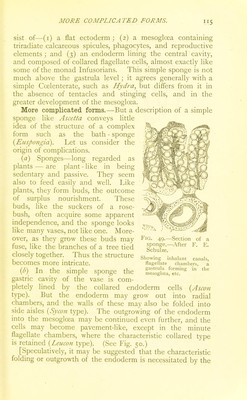
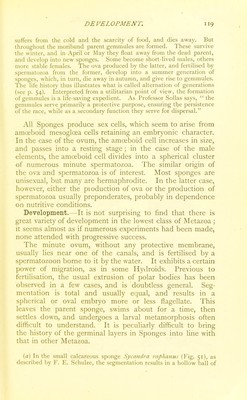
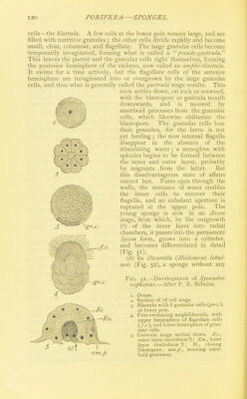
![fact that the endoderm cells are better nourished and multiply more rapidly than those of the ectoderm, which thus fails to keep pace A Ec Eti Fig. 50.—Diagram showing types of canal system.—After Korschelt and Heider. The flagellate regions are dark throughout, the mesogloea is dotted, the arrows show the direction of the currents. All the figures re- present cross-sections through the wall. A. Simple Ascon type (Ec., ectoderm; En., endoderm; Mg., mesogloea). B. Sycon type, with flagellate radial cham- bers (r.c.). C. Leucon type, with flagellate side aisles on the main radial chambers. D. Still more complex type, with small flagellate chambers {/. c/t.). with the inner layer.] (c) By infoldings of the skin—ectoderm and a subjacent sheath of meso- gloea—subdermal spaces may be formed ; an outer cortex may be distinctly differentiated from the internal region in which the flagellate chambers occur; the pores may collect into sieve - like areas, which open into dome-like cavities ; these and many other com- plications are common. (d) The ectoderm is usually described as a covering layer of flat epithelium, but flask- shaped cells have also been observed (Bidder). It may be folded inwards, as we have noticed, and, according to some, it also lines the incurrent or afferent canals in whole or in part. In a few cases, e.g. Oscarella lobiilaris, it is ciliated, and its cells may also exhibit contractility, as around the osculum of Ascetta clathrus, though the con- tractile elements usually belong to the mesogloea. The endoderm consists typically of collared flagellate cells, but in the more complex sponges these are replaced, except](https://iiif.wellcomecollection.org/image/b2195866x_0140.jp2/full/800%2C/0/default.jpg)