The electrolytic reduction of pheno- and naphtho-morpholones / by Frederic H. Lees and Frank Shedden.
- Lees, F. H. (Frederic Herbert)
- Date:
- [1903.]
Licence: In copyright
Credit: The electrolytic reduction of pheno- and naphtho-morpholones / by Frederic H. Lees and Frank Shedden. Source: Wellcome Collection.
9/20 page 756
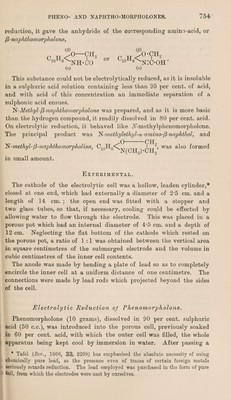
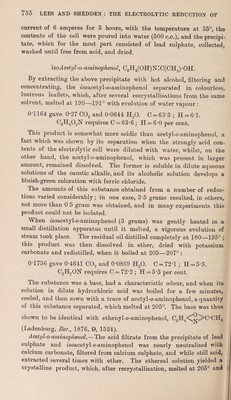
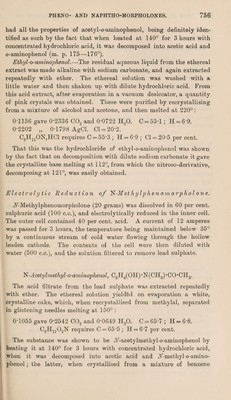
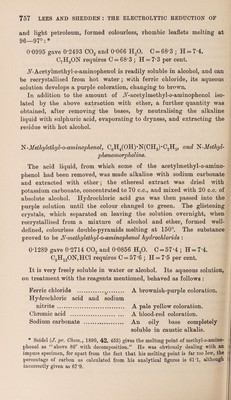
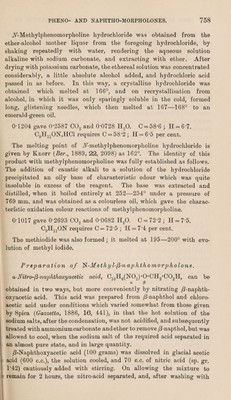
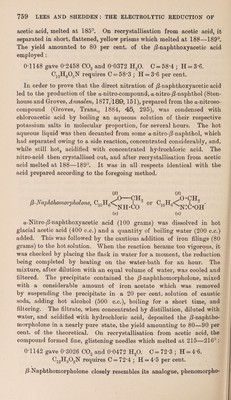
![had all the properties of acetyl-o-aminophenol, being definitely iden¬ tified as such by the fact that when heated at 140° for 3 hours with concentrated hydrochloric acid, it was decomposed into acetic acid and o-aminophenol (m. p. 175—176°). Ethyl-o-aminophenol.—The residual aqueous liquid from the ethereal extract was made alkaline with sodium carbonate, and again extracted repeatedly with ether. The ethereal solution was washed with a little water and then shaken up with dilute hydrochloric acid. From this acid extract, after evaporation in a vacuum desiccator, a quantity of pink crystals was obtained. These were purified by recrystallising from a mixture of alcohol and acetone, and then melted at 220°: 0T156 gave 0*2336 C02 and 0 0722 H90. C = 55T ; H = 69. 0*2202 „ 0-1798 AgCl. Cl = 20*2. C8HnON,HCl requires C = 55*3 ] H = 6‘9; Cl = 20‘5 per cent. That this was the hydrochloride of ethyl-o-aminophenol was shown by the fact that on decomposition with dilute sodium carbonate it gave the crystalline base melting at 112°, from which the nitroso-derivative, decomposing at 121°, was easily obtained. Electrolytic Reduction of N-Methylphenomorpholone. A-Methylphenomorpholone (20 grams) was dissolved in 60 per cent, sulphuric acid (100 c.c.), and electrolytically reduced in the inner cell. The outer cell contained 40 per cent. acid. A current of 12 amperes was passed for 3 hours, the temperature being maintained below 35° by a continuous stream of cold water flowing through the hollow leaden cathode. The contents of the cell were then diluted with water (500 c.c.), and the solution filtered to remove lead sulphate. 'N-Acetylmethyl-o-aminophenol, C6H4(OH)*N(CH3)*CO*CH3. The acid filtrate from the lead sulphate was extracted repeatedly with ether. The ethereal solution yielded on evaporation a white, crystalline cake, which, when recrystallised from methylal, separated in glistening needles melting at 150° : 0-1055 gave 0-2542 C02 and 0-0649 H20. C = 65 7 ; H = 68. C9H1]02N requires 0 = 655; H = 6'7 per cent. The substance was shown to be iV-acetylmethyl-o-aminophenol by heating it at 140° for 3 hours with concentrated hydrochloric acid, when it was decomposed into acetic acid and A-methyl-o-amino- phenol; the latter, when crystallised from a mixture of benzene](https://iiif.wellcomecollection.org/image/b30604527_0009.jp2/full/800%2C/0/default.jpg)
 No text description is available for this image
 No text description is available for this image
 No text description is available for this image