Licence: Public Domain Mark
Credit: Further observations on Pareiasaurus / by H.G. Seeley. Source: Wellcome Collection.
Provider: This material has been provided by The Royal College of Surgeons of England. The original may be consulted at The Royal College of Surgeons of England.
12/76 page 320
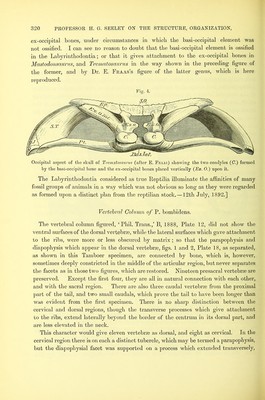
![ex-occipital bones, under circumstances in which the basi-occipital element was not ossified. I can see no reason to doubt that the basi-occipital element is ossified in the Labyrintliodontia; or that it gives attachment to the ex-occipital bones in Mastodonsaurus, and Trematosaurus in the way shown in the preceding figure of the former, and by Dr. E. Fraas’s figure of the latter genus, which is here reproduced. Fig. 4. Occipital aspect of tlie skull of Trematosaurus (after E. Fbaas) showing the two condyles (G.) formed by the basi-occij)ital bone and the ex-occipital bones placed vertically {Ex. 0.) npon it. The Labyrinthodontia considered as true Reptilia illuminate the affinities of many fossil groups of animals in a way which was not obvious so long as they were regarded as formed upon a distinct plan from the reptilian stock.—12th July, 1892.] Vertebral Column of P. bombidens. The vertebral column figured, ‘Phil. Trans.,’ B, 1888, Plate 12, did not show the ventral surfaces of the dorsal vertebrae, while the lateral surfaces which gave attachment to the ribs, were more or less obscured by matrix; so that the parapophysis and diapophysis which appear in the dorsal vertebrae, figs. 1 and 2, Plate 18, as separated, as shown in this Tamboer specimen, are connected by bone, which is, however, sometimes deeply constricted in the middle of the articular region, but never separates the facets as in those two figures, which are restored. Nineteen presacral vertebrae are preserved. Except the first four, they are all in natural connection with each other, and with the sacral region. There are also three caudal vertebrae from the proximal part of the tail, and two small caudals, which prove the tail to have been longer than was evident from the first specimen. There is no sharp distinction between the cervical and dorsal regions, though the transverse processes which give attachment ro the ribs, extend laterally beyond the border of the centrum in its dorsal part, and are less elevated in the neck. This character would give eleven vertebrae as dorsal, and eight as cervical. In the cervical region there is on each a distinct tubercle, which may be termed a parapophysis, but the diapopbysial facet was supported on a process which extended transversely.](https://iiif.wellcomecollection.org/image/b22417278_0014.jp2/full/800%2C/0/default.jpg)



 No text description is available for this image
 No text description is available for this image
 No text description is available for this image