Licence: Public Domain Mark
Credit: Further observations on Pareiasaurus / by H.G. Seeley. Source: Wellcome Collection.
Provider: This material has been provided by The Royal College of Surgeons of England. The original may be consulted at The Royal College of Surgeons of England.
3/76 page 311
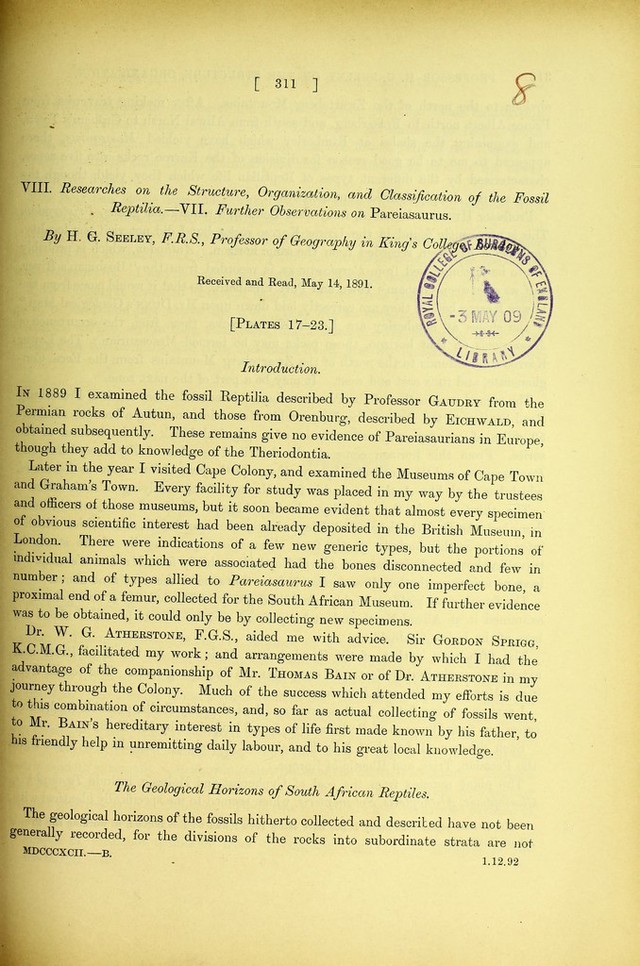
![VIII. Researches on^ the Structure, Organization, and Classification of the Fossil ■ R«ptilia.—Yll. Further Observations on Pareiasaurus. By H. G. Seeley, F.R.S., Professor of Geography in King. Received and Read, May 14, 1891. [Plates 17-23.] Introduction. Is 1889 I examined the fossil Eeptilia described by Professor Gaudey from the Permian rooks of Autun, and those from Orenburg, described by Eichwald, and obtained subsequently. These remains give no evidence of Pareiasaurians in Eiirope though they add to knowledge of the Theriodontia. Elder in the year I visited Cape Colony, and examined the Museums of Cape Town and Grahams Town. Every facility for study was placed in my way by the trustees and ofhcers of those museums, but it soon became evident that almost every specimen o 0 vious scientific interest had been already deposited in the British Museum, in • °r -T’ indications of a few new generic types, but the portions of individual animals which were associated had the bones disconnected and few in number; and of types allied to Pareiasaurus I saw only one imperfect bone, a proximal end of a femur, collected for the South African Museum. If further evidence was to be obtained, it could only be by collecting new specimens. F-G-S., aided me with advice. Sir Gordon Sprigs, . i.b-., lacilitated my work; and arrangements were made by which I had the advantage of the companionship of Mr. Thomas Bain or of D-r. Atheestone in my journey through the Colony. Much of the success which attended my efforts is due of circumstances, and, so far as actual collecting of fossils went to Mr. Bain’s hereditaiy interest in types of life first made known by his father to nis friendly help in unremitting daily labour, and to his great local knowledge. The Geological Hmnzons of South African Reptiles. The geological horizons of the fossils hitherto collected and described have not been generally recorded, for the divisions of the rocks into subordinate strata are not MDCCCXCII.—B. 1.12.92](https://iiif.wellcomecollection.org/image/b22417278_0005.jp2/full/800%2C/0/default.jpg)