Children at psychiatric risk / edited by E. James Anthony and Cyrille Koupernik.
- Date:
- [1974]
Licence: Attribution-NonCommercial-NoDerivatives 4.0 International (CC BY-NC-ND 4.0)
Credit: Children at psychiatric risk / edited by E. James Anthony and Cyrille Koupernik. Source: Wellcome Collection.
46/584 page 18
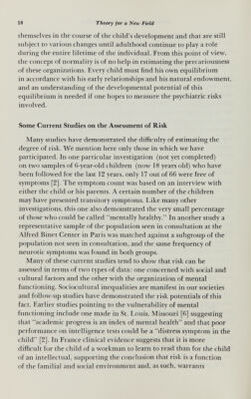
![18 Theory for a New Field themselves in the course of the child's development and that are still subject to various changes until adulthood continue to play a role during the entire lifetime of the individual. From this point of view, the concept of normality is of no help in estimating the precariousness of these organizations. Every child must find his own equilibrium in accordance with his early relationships and his natural endowment, and an understanding of the developmental potential of this equilibrium is needed if one hopes to measure the psychiatric risks involved. Some Current Studies on the Assessment of Risk Many studies have demonstrated the difficulty of estimating the degree of risk. We mention here only those in which we have participated. In one particular investigation (not yet completed) on two samples of 6-year-old children (now 18 years old) who have been followed for the last 12 years, only 17 out of 66 were free of symptoms [2]. The symptom count was based on an interview with either the child or his parents. A certain number of the children may have presented transitory symptoms. Like many other investigations, this one also demonstrated the very small percentage of those who could be called mentally healthy. In another study a representative sample of the population seen in consultation at the Alfred Binet Center in Paris was matched against a subgroup of the population not seen in consultation, and the same frequency of neurotic symptoms was found in both groups. Many of these current studies tend to show that risk can be assessed in terms of two types of data: one concerned with social and cultural factors and the other with the organization of mental functioning. Socioculturai inequalities are manifest in our societies and follow-up studies have demonstrated the risk potentials of this fact. Earlier studies pointing to the vulnerability of mental functioning include one made in St. Louis, Missouri [6] suggesting that academic progress is an index of mental health and that poor performance on intelligence tests could be a distress symptom in the child [2]. In France clinical evidence suggests that it is more difficult for the child of a workman to learn to read than for the child of an intellectual, supporting the conclusion that risk is a function of the familial and social environment and, as such, warrants i](https://iiif.wellcomecollection.org/image/b18021876_0047.JP2/full/800%2C/0/default.jpg)