Children at psychiatric risk / edited by E. James Anthony and Cyrille Koupernik.
- Date:
- [1974]
Licence: Attribution-NonCommercial-NoDerivatives 4.0 International (CC BY-NC-ND 4.0)
Credit: Children at psychiatric risk / edited by E. James Anthony and Cyrille Koupernik. Source: Wellcome Collection.
54/584 page 26
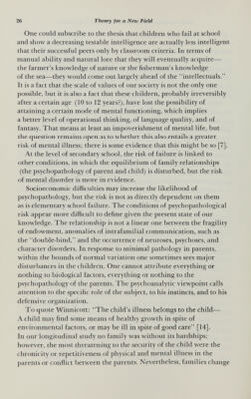
![26 Theory for a New Field One could subscribe to the thesis that children who fail at school and show a decreasing testable intelligence are actually less intelligent that their successful peers only by classroom criteria. In terms of manual ability and natural lore that they will eventually acquire— the farmer's knowledge of nature or the fisherman's knowledge of the sea—they would come out largely ahead of the intellectuals. It is a fact that the scale of values of our society is not the only one possible, but it is also a fact that these children, probably irreversibly after a certain age (10 to 12 years?), have lost the possibility of attaining a certain mode of mental functioning, which implies a better level of operational thinking, of language quality, and of fantasy. That means at least an impoverishment of mental life, but the question remains open as to whether this also entails a greater risk of mental illness; there is some evidence that this might be so [7]. At the level of secondary school, the risk of failure is linked to other conditions, in which the equilibrium of family relationships (the psychopathology of parent and child) is disturbed, but the risk of mental disorder is more in evidence. Socioeconomic difficulties may increase the likelihood of psychopathology, but the risk is not as directly dependent on them as is elementary school failure. The conditions of psychopathological risk appear more difficult to define given the present state of our knowledge. The relationship is not a linear one between the fragility of endowment, anomalies of intrafamilial communication, such as the double-bind, and the occurrence of neuroses, psychoses, and character disorders. In response to minimal pathology in parents, within the bounds of normal variation one sometimes sees major disturbances in the children. One cannot attribute everything or nothing to biological factors, everything or nothing to the psychopathology of the parents. The psychoanalytic viewpoint calls attention to the specific role of the subject, to his instincts, and to his defensive organization. To quote Winnicott: The child's illness belongs to the child— A child may find some means of healthy growth in spite of environmental factors, or may be ill in spite of good care [14]. In our longitudinal study no family was without its hardships; however, the most threatening to the security of the child were the chronicity or repetitiveness of physical and mental illness in the parents or conflict between the parents. Nevertheless, families change](https://iiif.wellcomecollection.org/image/b18021876_0055.JP2/full/800%2C/0/default.jpg)