Licence: Public Domain Mark
Credit: Mental diseases / by Charles F. Folsom. Source: Wellcome Collection.
Provider: This material has been provided by the University of Massachusetts Medical School, Lamar Soutter Library, through the Medical Heritage Library. The original may be consulted at the Lamar Soutter Library at the University of Massachusetts Medical School.
100/122 page 188
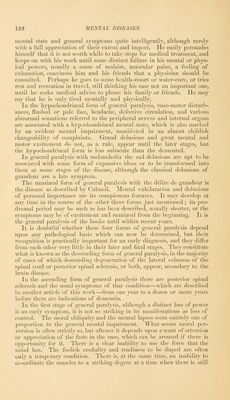
![mental state and general symptoms quite intelligcDtly, although rarely with a full api)reciatiou of their extent and imj)ort. He easily persuades himself that it is not worth while to take steps for medieal treatment, and keeps on with his work until some distinet failure iu his mental or phys- ieal powers, usually a sense of malaise, muscular pains, a feeling of exhaustion, convinces him and his friends that a physician should be consulted. Perhaps he goes to some health-resort or water-cure, or tries rest and recreation in travel, still thinking his case not an important one, until he seeks medical advice to please his family or friends. He may say that he is only tired mentally and jjhysically. In the hypochondriacal form of general paralysis, vaso-motor disturb- ances, flushed or pale face, headache, defective circulation, and various abnormal sensations referred to the peripiieral nerves and internal organs are associated with a hypochondriacal mental state, \vhi(;h is also marked by an evident mental impairment, manifested in an almost childish changeability of complaints. Grand delusions and great mental and motor excitement do not, as a rule, appear until the later stages, but the hypochondriacal form is less subacute than the demented. In general paralysis with melancholia the sad delusions are apt to be associated with some form of expansive ideas or to be transformed into them at some stages of the disease, although the classical delusions of grandeur are a late symptom. The maniacal form of general paralysis with the delire de grandeur is the disease as described by Calmeil. Mental exhilaration and delusions of personal importance are its conspicuous features. It may develop at any time in the course of the other three forms just mentioned; its j)ro- dromal period may be such as has been described, usually shorter, or the svmptonis may be of excitement and maniacal from the beginning. It is the general paralysis of the books until within recent years. It is doubtful whether these four forms of general paralysis depend upon any pathological basis which can now be determined, but their recognition is practically important for an early diagnosis, and they differ from each other very little in their later and final stages. They constitute what is known as the descending form of general paralysis, in the majority of cases of Avhich descending degeneration of the lateral columns of the spinal cord or posterior spinal sclerosis, or both, a[)pear, secondary to the brain disease. In the ascending form of general ]iaralysis there are ]>osterior spinal sclerosis aud the usual sym])toms of tliat condition—which arc described in another article of this work—from one year to a dozen or more years before there are indications of dementia. In the first stage of general paralysis, although a distinct loss of power is an early symptom, it is not so striking in its manifestations as loss of control. The moral obli(|uity and the mental lapses seem entirely out of proportion to the general mental impairment. What seems moral per- version is often strictly so, but oftener it depends upon a want of attention or appreciation of the facts in the case, which can be aroused if there is opi)ortnnity for it. There is a clear inability to use the force that the mind has. The foolish credulity and readiness to be duped are often only a temporary condition. Tiiere is, at the same time, an inability to co-ordinate the muscles to a striking dei>ree at a time when there is still](https://iiif.wellcomecollection.org/image/b2119760x_0100.jp2/full/800%2C/0/default.jpg)