Licence: Public Domain Mark
Credit: Mental diseases / by Charles F. Folsom. Source: Wellcome Collection.
Provider: This material has been provided by the University of Massachusetts Medical School, Lamar Soutter Library, through the Medical Heritage Library. The original may be consulted at the Lamar Soutter Library at the University of Massachusetts Medical School.
101/122 page 189
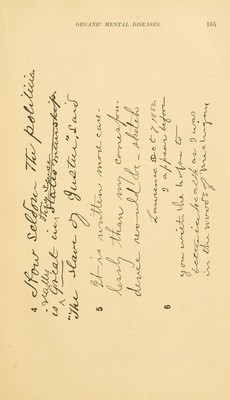
![only sliglit impairment of the muscular strength, or inversely, and the co-ordinating power may improve up to a certain point, while the mus- cular impairment goes on. This ataxia is first noticed in those nuiscles requiring the nicest adjustment for their usual work, the penman's and the pianist's fingers, the proofreader's eyes, the singer's throat. But it may be for a long time very slight or not easily detected. Although this nuiscular ataxia may be observed, even if not constantly, in the prodromal period of general paralysis, it is usually well marked only when the symptoms have become well developed. There is also a fibrillary tremor of one group of muscles or of one set of fibres after anotlier when these muscles are exerted, and increasing as they become wearied, as they soon do, from the exercise. The handwriting may show no conspic- uous fault at the top of the page, and at the bottom be full of evidences of muscular tremor and unsteadiness, or a single word may be written with- out conspicuous fault, and a few lines serve to show ataxia of the muscles used in writing. In beginning to read there maybe only the most trifling want of clearness of tone and steadiness of articulation, noticeable only to the most practised ear, Mdiich after a number of minutes becomes a dis- tinct harshness of voice or evident stumbling over Unguals and labials, or hesitation in speech, which may seem like the utterance of a person slightly under the influence of wine or with lips cold from frosty air. The hesi- tancy of speech is due partly to a slower flow of ideas than in health, an impaired power of attention to the subject in hand, a diminished creative power or expression of thoughts, but also to a distinct ataxia, an inability to promptly co-ordinate the muscles required to perform the act. The difficulty in reading is partly mental and in part due to inco-ordination of the muscles governing the eyes as well as those of articulation. These muscular defects and mental inefficiencies, Mhen slight, may be hardly detected after the patient has had a prolonged rest and is quiet and calm. After some emotional irritation, weariness, sleeplessness, vaso- motor disturbances, or congestive attacks they become very pronounced. After several weeks of absolute rest, with the patient still at rest, it may be impossible for a time to find any trace of mental defect or muscular deficiency until the patient has again been ])ut to the strain following some effort. They are very much increased after epileptiform or apoplec- tiform attacks, M'hich, however, are uncommon so early in the case. In the progress of the disease, as the mental imjiairment increases, the reaction of the nervous system to external conditions becomes less active, the mind weakens, the loss of flesh may be, at least in part, regained, a great portion of the irritability and active symptoms disappears, and as the patient grows worse he may seem for a while to his friends to improve. The leading sym])toms of general paralysis of the insane are—(1) vaso- motor, (2) mental, (3) physical. The vaso-motor symptoms consist in a progressive paresis or lessened power, which in the progress of the disease advances to complete arterial paralysis—at first a functional disorder of impaired innervation, and finally organic. They are marked early by ra]iid changes in the cerebral circulation, a diminished arterial tension, with occasional or frequent attacks of vertigo, dizziness, or faintness, confusion and incoherence that may amount to a transient dementia, localized and general elevation or](https://iiif.wellcomecollection.org/image/b2119760x_0101.jp2/full/800%2C/0/default.jpg)