Licence: Public Domain Mark
Credit: Mental diseases / by Charles F. Folsom. Source: Wellcome Collection.
Provider: This material has been provided by the University of Massachusetts Medical School, Lamar Soutter Library, through the Medical Heritage Library. The original may be consulted at the Lamar Soutter Library at the University of Massachusetts Medical School.
99/122 page 187
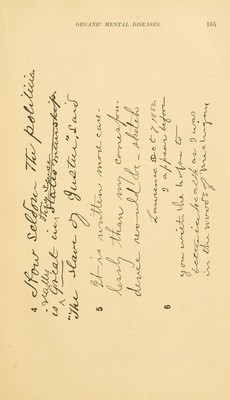
![with care, after a loniz; rest, and, as compared -svitli liis former -writiiii^ when done with equal care, there is seen only a wider separation of the letters. Its general appearance, on casual inspection, is better timn that of his ordinary writing before his illness, as that Avas hurried and careless. But the second or third page brings out the ataxia dis- tinctly. It shows how well a general paralytic, under the influence of rest and quiet, luay control certain groups of muscles—how completely the ataxia may be concealed under an ordinary examination; and yet the symptoms in his case may be clearly brought out by the method just described. The tongue was quite tremulous. The writer of No. 6 was more advanced in general paralysis, but had been thought not to be ataxic, from the fact that he had been able to write a single word pretty well. His few lines are quite characteristic of a general paralytic. Although he was in my office in Boston, he dated his statement from his home, and wrote the word Lawrence not badly for a man not in the habit of writing much. Seeing me for the first time, he addressed me as Friend Folsom, and he signed his name by his old army title of nearly twenty years before—corporal. The characteristic writing in advanced general paralysis, irregular, dis- torted, full of omissions of letters and words, and finally illegible, may be seen in the textbooks on insanity. It very rarely ha]->pens that the onset and early progress of general paralysis are so sudden and rapid that there is no prodromal period or that it is very short. The symptoms of well-marked general paralysis include four tolerably distinct types, as follows: (1) The demented and paralytic; (2) the hypo- chondriacal; (3) with melancholia; (4) witii exaltation and mania. There are mixed cases in which some or all of these forms occur. The period of invasion or prodromal period, be it short or long, has, as a rule (not ahvavs), gone by when the disease has arrived at a point in its progress to be definitely placed in any or several of these four types. The demented form of general paralysis is the most common, and is also that in which the greatest increase has been noticed during the last decade, whether from more accurate diagnosis or by reason of an actually greater proportion, probably to a certain extent due to both causes. It consists in a very slowly-advancing mental impairment, making progress side by side with muscular loss of control and power, which may continue several months or years before their importance is appreciated, the vaso- motor disturbances not being so marked as in more acute forms of the disease, and the changes in the mental state and bodily strength from Aveek to week being so slight as to escape observation. Attacks of dizzi- ness, petit mal, and e])ileptiform seizures are quite common in this type of general pai-alysis. In one of my cases a lawyer in the third year of the disease was retained as counsel in a will case involving over a million dollars, when he fell repeatedly in the streets, and when his occasional, indeed frequent, mental lapses were so apparent to his ])artners that they did not allow any of his business letters to leave the office without being first inspected by them. Mental excitement, maniacal symptoms, and delusions of grandeur rarely occur, except as transient attacks, until the final stages. The patient commonly realizes that something is the matter with him until he becomes quite demented, and can often describe his](https://iiif.wellcomecollection.org/image/b2119760x_0099.jp2/full/800%2C/0/default.jpg)