Licence: Public Domain Mark
Credit: The rate of mortality in Manchester / by James Whitehead. Source: Wellcome Collection.
Provider: This material has been provided by The Royal College of Surgeons of England. The original may be consulted at The Royal College of Surgeons of England.
46/70 page 42
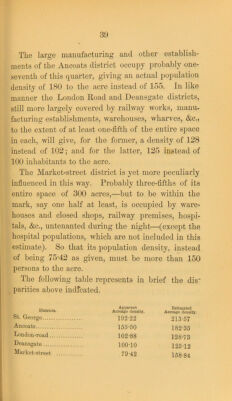
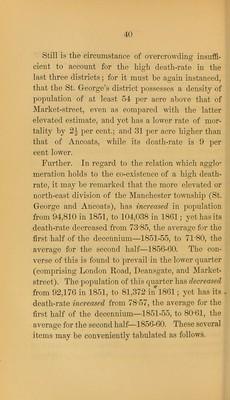
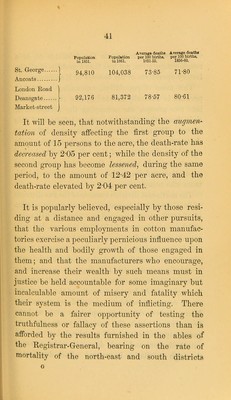
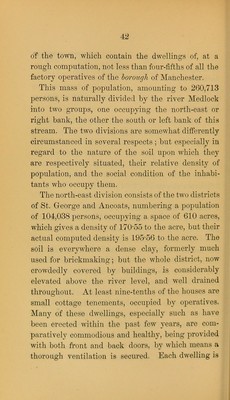
![of the town, which contain the dwellings of, at a rough computation, not less than four-fifths of all the factory operatives of the borough of Manchester. This mass of population, amounting to 260,713 persons, is naturally divided by the river Medlock into two groups, one occupying the north-east or right bank, the other the south or left bank of this stream. The two divisions are somewhat differently circumstanced in several respects ; but especially in regard to the nature of the soil upon which they are respectively situated, their relative density of population, and the social condition of the inhabi- tants who occu]3y them. The north-east division consists of the two districts of St. George and Ancoats, numbering a population of 104,038 persons, occupying a space of 610 acres, which gives a density of 170'55 to the acre, but their actual computed density is 195-56 to the acre. The soil is everywhere a dense clay, formerly much used for briclmiaking; but the whole district, now crowdedly covered by buildings, is considerably elevated above the river level, and well drained throughout. At least nine-tenths of the houses are small cottage tenements, occupied by operatives. Many of these dwellings, especially such as have been erected within the past few years, are com- paratively commodious and healthy, being provided with both fi’ont and back doors, by which means a thorough ventilation is secured. Each dwelling is](https://iiif.wellcomecollection.org/image/b22337544_0048.jp2/full/800%2C/0/default.jpg)

 No text description is available for this image
 No text description is available for this image
 No text description is available for this image