A cyclopaedia of practical receipts, and collateral information in the arts, manufactures, professions, and trades, including medicine, pharmacy, and domestic economy : designed as a comprehensive supplement to the pharmacopœias, and general book of reference for the manufacturer, tradesman, amateur, and heads of families / by Arnold J. Cooley.
- Arnold James Cooley
- Date:
- 1856
Licence: Public Domain Mark
Credit: A cyclopaedia of practical receipts, and collateral information in the arts, manufactures, professions, and trades, including medicine, pharmacy, and domestic economy : designed as a comprehensive supplement to the pharmacopœias, and general book of reference for the manufacturer, tradesman, amateur, and heads of families / by Arnold J. Cooley. Source: Wellcome Collection.
Provider: This material has been provided by The University of Leeds Library. The original may be consulted at The University of Leeds Library.
1298/1368 (page 1280)
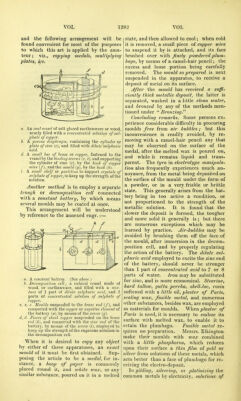
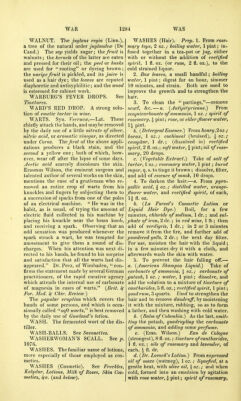
![when swollen or congested, to remove chronic ophthalmia,purulent discharges, 8fc., nothing is equal to frequently bathing them with water, at Jirst tepid, but afterwards lowered in temperature to absolute coldness. The Eye-douche of Mr. Heather Bigg, of Leicester Square, is an admirable invention for this purpose. VITAROBORANT (Palmer's). Resem- bles ervalenta. VITRIFIABLE PIGMENTS. See Ena- mels. VITRIFICATION. See Glass. VITRIOL or Green vitriol. Commercial sulphate of iron. VITRIOL (Blue). Commercial sulphate of copper. VITRIOL (Roman). As the last. VITRIOL (White). Commercial sulphate of zinc. VITTIE VAYR. Syn. Vetiver. The Tamool name of the odorous and fihrous roots of the andropogon miiricatum (antho- xanthum niuricatus,—Linn.), recently sold by the perfumers. VOLTAIC BATTERY. Syn. Galvanic Battery. An instrument or apparatus for the production of an electrical current by chemical decomposition. One of the most useful forms of the galvanic battery is that proposed by Pi'o- fessor Daniell, and commonly known by his name. Its peculiar advantages arise from its action continuing without inter- ruption, for a long time, hence the name of constant battery that has been applied to it. The following figure will explain its construction and application:— A. A copper cylinder filled with a saturated solution of sulphate of copper. B. A sniKller porous cylinder or membrane, con- taining a niixtiive of 1 pai't of oil of vitriol, and about 7 of water. C. A rod of zinc supported in the smaller cylinder by the cross piece {i). D. A shelf fuU of small holes, for supporting crystals of sulphate of copper, to keep up the strength of the solution. e and/. Screias and caps to connect tlie wires and /( with the battery. ff. Tlie positii'd wire. h. The negative wire. \ One of these batteries is sufficient for electrotyping ; six of them form a circle of considerable power, and about 20, produce one sufficiently strong for most experi- ments of demonstration and research. In arranging these, as well as other bat- teries, when intensity, or travelling power, is desired, the metallic communication is made between the cpposite metals; but when simple quantity without intensity is required, the zinc of one battery is united with the zinc of the other, and the copper of the one with the copper of the other, an effect which is equally attainable with a single battery of enlarged dimensions. VOLTAIC BRASSING. An actual deposit of copper and zinc in the state of alloy forming brass, may be obtained by employing the following solution for the decomposition cell: — Sesquicarbonate of ammonia and cyanide of potassium, of each, 1 lb. ; cyanide of copper, 2 oz. ; cyanide of zinc, 1 oz. ; water, 1 gall.; dissolve. If the deposit be too red, add some more am- monia ; if too pale, add more cyanide of potassium. See Vo/ati/pe. VOLTAIC COPPERING. A solution of the sulphate of copper for the decomposition cell; or, for fne work, a liquid formed by dissolving blac/c oxide of copper or ferro- cyanide of copper in a solution of cyanide of potassium, the solution being neutralized, from time to time, with a little caustic potassa. See Voltatype. VOLTAIC GILDING. Various solutions have heen recommended by different au- thorities for the decom])osition cell. M. De la Rive employs a solution of neutral tercliloride of gold; M. Dumas, a solution formed of 31 grammes and 25 centigrammes of gold converted into oxide; 5 hecto- grammes of cyanuret of potassium ; and water, 4 litres ; boiled for half an hour in glass or porcelain ; used with a constant battery (gilds very quickly, especially when boiling); M. Louyet, a strong solution of bisulphuret of gold in cyanide of potassium, with a powerful electric current; M. Ruolz, a solution of cyanide, chloride, or potassio- chloride of gold, in cyanide of potassium or red or yellow prussiate of potash, a solution ■ of sodio-chloride of gold in carbonate of soda, or of sulphuret of gold in neutral cyanide or sulphuret of potassium ; Messrs. Elkington (under patent dated March, 1840), employ a solution of cyanide of gold in cyanide of potassium, formed by either directly dissolving the former in the latter, or by subjecting the metallic gold to the joint action of a solution of cyanide of potassium and electricity. In 1841, Mr.](https://iiif.wellcomecollection.org/image/b21535528_1298.jp2/full/800%2C/0/default.jpg)