A cyclopaedia of practical receipts, and collateral information in the arts, manufactures, professions, and trades, including medicine, pharmacy, and domestic economy : designed as a comprehensive supplement to the pharmacopœias, and general book of reference for the manufacturer, tradesman, amateur, and heads of families / by Arnold J. Cooley.
- Arnold James Cooley
- Date:
- 1856
Licence: Public Domain Mark
Credit: A cyclopaedia of practical receipts, and collateral information in the arts, manufactures, professions, and trades, including medicine, pharmacy, and domestic economy : designed as a comprehensive supplement to the pharmacopœias, and general book of reference for the manufacturer, tradesman, amateur, and heads of families / by Arnold J. Cooley. Source: Wellcome Collection.
Provider: This material has been provided by The University of Leeds Library. The original may be consulted at The University of Leeds Library.
1324/1368 (page 1306)
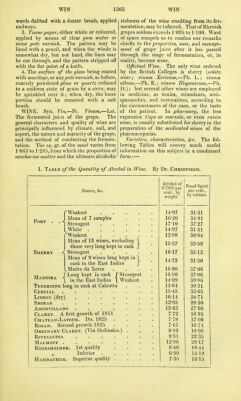
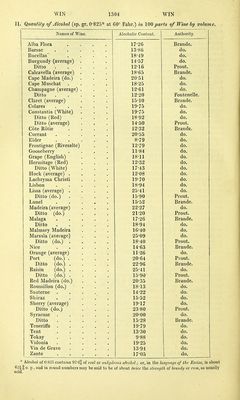
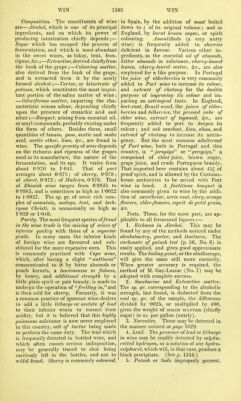
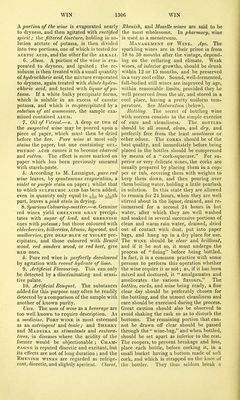
![A portion of the wine is evaporated nearly to dryness, and then agitated with rectified spirit; i\\e filtered tincture, holding in so- lution acetate of potassa, is then divided into two portions, one of which is tested for ACETIC ACID, and the other for the alkali. 6. Alum. A portion of the wine is eva- porated to dryness, and ignited ; the re- siduum is then treated with a small quantity o{ hydrochloric acid, the mixture evaporated to diyness, again treated with dilute hydro- chloric acid, and tested with liquor of po- tassa. If a white bulky precipitate forms, which is soluble in an excess of caustic potassa, and which is re-precipitated by a solution of sal ammoniac, the sample exa- mined contained alum. 7. Oil of Vitriol.—a. A drop or two of the suspected wine may be poured upon a piece of paper, which must then be dried before the fire. Pure wine at most only stains the paper, but one containing sul- phuric ACID causes it to l)ecoine charred and rotten. The effect is more marked on paper which has been previously smeared with starch-paste. b. According to M. Lassaigne, pure red wine leaves, by spontaneous evaporation, a violet orpuiple stain on paper; whilst that to which SULPHURIC ACID has been added, even in quantity only equal to t^-^^^ to j^jjjjth part, leaves a pink stain in drying. 8. Spurioics Colouring-matter.—a. Genuine red wines yield greenish gray precipi- tates with sugar of lead, and greenish ones vi\t\i potassa ; but those coloui'ed with elderberries, bilberries, litmus, logwood, and mulberries, give deep blue or violet pre- cipitates, and those coloured with Brazil wood, red sanders wood, or red beet, give red ones. b. Pure red wine is perfectly decoloured by agitation with recent hydrate of lime. 9. Artificial Flavouring. This can only be detected by a discriminating and sensi- tive palate. 10. Artificial Bouquet. The substances added for this purpose may often be readily detected by a comparison of the sample with another of known purity. Uses. The uses of wine as a beverage are too well known to require description. As a medicine. Port wine is most esteemed as an astringent and tonic; and Sherry and Madeira as stimulants and restora- tives, in diseases where the acidity of the former would be objectionable ; Cham- pagne is reputed diuretic and excitant, but its effects are not of long duration ; and the Rhenish wines are regarded as refrige- rant, diuretic, and slightly aperient. Claret, Rhenish, and Moselle wines are said to be the most wholesome. In pharmacy, wine is used as a menstruum. ]\Ianagement of Wine. Age. The sparkling wines are in their prime in from 18 to 30 mouths after the vintage, depend- ing on the cellaring and climate. Weak wines, of inferior growths, should be drunk within 12 or 13 months, and be preserved in a very cool cellar. Sound, well-ferraented, full-bodied still wines are improved by age, within reasonable limits, provided they be well preserved from the air, and stored in a cool place, having a pretty uniform tem- perature. See Maturation (below). Bottling. The secret of bottling wine with success consists in the simple exercise of care and cleanliness. The bottles should he all .lound, clean, and dry, and perfectly free from the least mustiness or other otlour. The corks should be of the best quality, and immediately before being placed in the bottles should be compressed by means of a cork-squeezer. For su- perior or very delicate wines, the corks are usually prepared by placing them in a cop- per or tub, covering them with weights to keep them down, and then pouring over them boiling water, holding a little pearlash in solution. In this state they are allowed to remain for 21 hours, when they are well stirred about in the liquor, drained, and re- immersed for a second 21 hours in hot water, after which they are well washed and soaked in several successive portions of clean and warm rain water, drained, dried out of contact with dust, put into paper bags, and hung up in a dry place for use. The wine should be clear and brilliant, and if it be not so, it must undergo the process of fining before being bottled. In fact, it is a common practice with some persons to perform this operation whether the wine require it ornot; as, if it has been mixed and doctored, it amalgamates and ameliorates the various flavours. The bottles, corks, and wine being ready, a fine clear day shoidd be preferably chosen for the botthng, and the utmost cleanliness and care should be exercised during the process. Great caution should also be observed to avoid shaking the cask so as to disturb the bottoms. The remaining portion that can- not be drawn off clear should be passed through the wine-bag, and when bottled, should be set apart as inferior to the rest. The coopers, to prevent breakage and loss, place each bottle, before corking it, in a small bucket having a bottom made of soft cork, and which is strapped on the knee of the bottler. They thus seldom break a](https://iiif.wellcomecollection.org/image/b21535528_1324.jp2/full/800%2C/0/default.jpg)