Second report of the Departmental Committee appointed to inquire into the law relating to coroners and coroners' inquests, and into the practice in coroners' courts.
- Great Britain. Committee on Coroners.
- Date:
- 1909
Licence: Public Domain Mark
Credit: Second report of the Departmental Committee appointed to inquire into the law relating to coroners and coroners' inquests, and into the practice in coroners' courts. Source: Wellcome Collection.
77/232 (page 47)
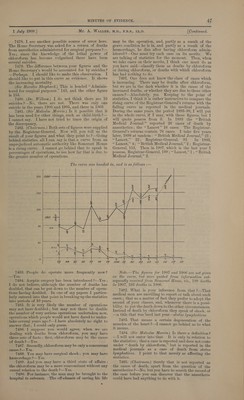
![1 July 1909.] (Continued. 7478. I see another possible source of error here. The Home Secretary was asked for a return of deaths from anesthetics administered for surgical purposes P— Yes; since the knowledge of the lethal power of chloroform has become yulgarised there have been several suicides. 7479. The difference between your figures and the Home Secretary's would be accounted for by suicides ? —Perhaps. I should like to make this observation. I should like to put in this curve as evidence. It shows the increasing mortality. (Str Horatio Shephard.) This is headed “ Adminis- tered for surgical purposes” 143, and the other figure is 153. 7480. (Dr. Willcow.) I do not think there are 10 suicides ?—No, there are not. There was only one suicide in the years 1900 and 1905, and three in 1903. 7481. (Sir Malcolm Morris.) Is it possible that it has been used for other things, such as child-birth P— I cannot say. I have not tried to trace the origin of the discrepancy. 7482. (Chairman.) Both sets of figures were supplied by the Registrar-General. Now will you tell us the result of your figures and what they point to ?—Going behind statistics, all I can say is that a curve from an unprejudiced automatic authority like Somerset House is a rising curve. I cannot go behind that to speak in percentages of operations, to see how far that is due to the greater number of operations. may be the operation, and, partly as a result of the grave condition he is in, and partly as a result of the hemorrhage, he dies after having chloroform admin- istered P—One must try each case on its merits. We are talking of statistics for the moment. Then, when we take cases on their merits, I think one must do as you have said—classify them as deaths by chloroform or during chloroform, or deaths with which chloroform has had nothing to do. 7491. One does not know the class of cases which is increasing. There may be deaths after chloroform, but we are in the dark whether it is the cause of the increased deaths, or whether they are due to these other causes P—Absolutely, yes. Keeping to the point of statistics, I think it is rather instructive to compare the rising curve of the Registrar-General’s returns with the falling curve as reported in the medical journals. During the same years, the period 1893-98, I will put in the whole curve, if I may, with these figures, but I will quote passim from it. In 1893 the “British Medical Journal” reported 26 cases of death by anesthetics; the ‘ Lancet” 16 cases. The Registrar- General’s returns contain 76 cases. I take five years later, 1898 at random: “ British Medical Journal,” 21 ; “Tancet,” 22; Registrar-General, 91. In 1903, “Lancet,” 4; ‘‘ British Medical Journal,” 2; Registrar- General, 153, Then in 1907, which is the last year I possess, Registrar-General, 199 ; “ Lancet,” 1 ; “ British Medical Journal,” 2. 7483. People do operate more frequently now? —Yes. 7484. Aseptic surgery has been introduced ?—Yes ; I do not believe, although the number of deaths has doubled, that can be put down to the number of opera- tions having doubled. In one of my papers I particu- larly entered into that point in breaking up the statistics into periods of 10 years. 7485. It is very likely the number of operations may not have doubled; but may not there be double the number of very serious operations undertaken now, operations which people would not have dared to under- take several years ago ?—I have absolutely no right to answer that; I could only guess. 7486. I suppose you would agree, when we are dealing with deaths from chloroform, you may have three sets of facts: first, chloroform may be the cause of death >—Yes. 7487. Secondly, chloroform may be only a concurrent cause P—Yes. 7488. You may have surgical shock; you may have hemorrhage ?—Yes. 7489. And you may have a third state of affairs: the chloroform may be a mere concomitant without any causal relation to the death >—Yes. 7490. For instance, the man may be brought to the hospital in eatremis. The off.chance of saving his life e ae Note—The figures for 1907 and 1906 are not given on the curve, but were quoted from information sub- sequently received from Somerset House, viz., 199 deaths zn 1907, 193 deaths in 1906. 7492. What is your inference from that ?—That medical men are unwilling to report or talk about such cases ; that as a matter of fact they prefer to adopt the second of your classes, and, whenever there is a possi- bility, to put the death down to the other circumstances. Instead of death by chloroform they speak of shock, or —a title that was ‘used last year—status lymphaticus. 7493. That means a certain degeneration of the muscles of the heart ?—I cannot go behind as to what it means. 7494. (Str Malcolm Morris.) Is there a definition ? —I will not enter into that. It is only in relation to the statistics ; thata case is reported and does not come under “death by chloroform,” but is reported in the medical journals as a case of death from status lymphaticus. I point to.that merely as affecting the statistics. 7495. (Chatrman.) Surely that is not reported as the cause of death, apart from the question of the anzesthetics P—No, but you have to search the record of the case before you can discover that the anesthetic could have had anything to do with it,](https://iiif.wellcomecollection.org/image/b32178098_0077.jp2/full/800%2C/0/default.jpg)