Surgery : its theory and practice / by William Johnson Walsham.
- William Walsham
- Date:
- 1897
Licence: Public Domain Mark
Credit: Surgery : its theory and practice / by William Johnson Walsham. Source: Wellcome Collection.
Provider: This material has been provided by The University of Leeds Library. The original may be consulted at The University of Leeds Library.
729/898 page 713
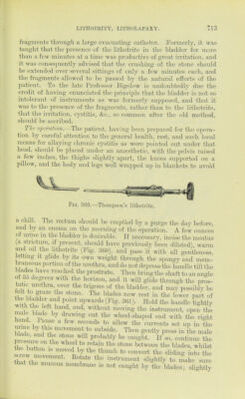
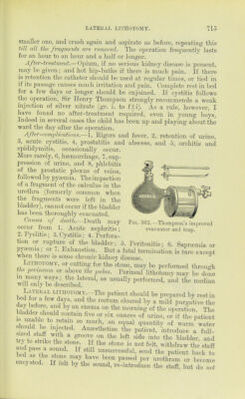
![fragments through a large evacuating catheter, formerly, it was taught that the presence of the lithotrite in the bladder for more than a few minutes at a time was productive of great irritation, and it was consequently advised that the crushing of the stone should be extended over several sittings of only a few minutes each, and the fragments allowed to be passed by the natural efforts of the patient. To the late Professor Bigelow is undoubtedly due the credit of having enunciated the principle that the bladder is not so intolerant of instruments as was formerly supposed, and that it was to the presence of the fragments, rather than to the lithotrite, that the irritation, cystitis, &c, so common after the old method, should be ascribed. . The <']> ration. —The patient, having 1 n prepared for the opera- tion by careful attention to the general health, rest, and such local means for allaying chronic cystitis as were pointed out under that head, should be placed under an ansesthetic, with the pelvis raised a^few inches, the thighs slightly apart, the knees supported on a pillow, and the body and legs well wrapped up in blankets to avoid Fig. 360.—Thompson's lithotrite. a chill. The rectum shoidd be emptied by a purge the day before, and by an enema on the morning of the operation. A few ounces oi urine m the bladder is desirable. If necessary, incise the meal us (a stricture, if present, should have previously been dilated), warm and oil the lithotrite (Kg. 3(30), and pass it will, all gentleness, letting it glide by its own weight through the spongy and mem- ■raneous portion of the urethra, and do not depress the handle till the blades have reached the prostrate. Then bringthe .halt to an angle of Bo degrees with the horizon, and it will glide through the pros- tatic urethra over the trigone of the bladder, and may possibly be felt to graze the stone. The blades now rest in the lower part of P°mt lairds (Fig. 361), Hold the handle tightly with the eft hand, and, without moving the instrument, open the male blade by drawing out the wheel-shaped end with the right Hand Pause a few seconds to allow the currents set up in the Made I fit 1,107ement11t0 s\bside. Then gently press in the male Pr n' 1 the TZlU P+r°>Sy bG °aU^- Bao, continue the the n ft Bi\t0 ^ the St0He between ^ Wades, whilst the button is moved by the thumb to convert the sliding into the screw movement. Rotate the instrument slightly to make sure that the mucous membrane is not caught by the blades; slightly](https://iiif.wellcomecollection.org/image/b21514392_0729.jp2/full/800%2C/0/default.jpg)