Surgery : its theory and practice / by William Johnson Walsham.
- William Walsham
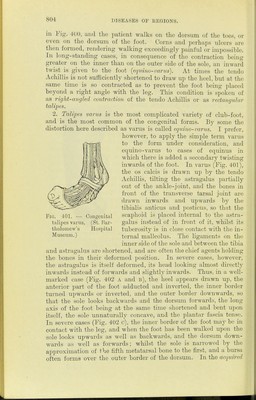
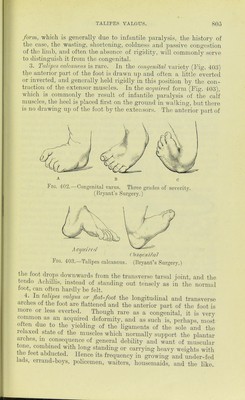
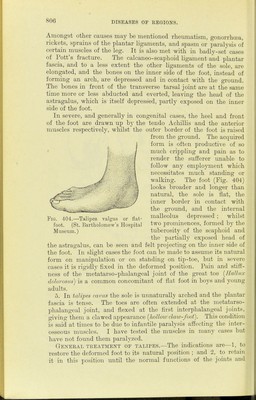
- Date:
- 1897
Licence: Public Domain Mark
Credit: Surgery : its theory and practice / by William Johnson Walsham. Source: Wellcome Collection.
Provider: This material has been provided by The University of Leeds Library. The original may be consulted at The University of Leeds Library.
818/898 page 802
![in cither operation should be merely long enough to admit the chisel, may in each ho made vertically two fingers' breadth above the patella and midway between the inner edge of the rectus and the tendon of the adductor magnus. The operations should be performed antiseptically and the ]imb secured to a long splint, or placed in Bavarian plaster splints in a straight position for about a month, and subsequently kept in an ordinary plaster case for six weeks to two months till sound union has taken place. Genu varum, or bow-legs, is the opposite deformity to genu valgum, and what has been said of the latter as regards pathology, treatment, &c, will apply to it if external be substituted for inter- nal in the phraseology. It is frequently associated with a bowing of the shaft of the tibia, either at its upper or its lower third, and sometimes with a bowing of the femur. Genu recurvatum or extrorsum is a condition of over-exten- sion at the knee. It is frequently present in a slight degree in cases of knock-knee. It sometimes occurs as a congenital affection; the hyper-extension may then be extreme, the feet touching the groins. When it is combined with knock-knee the irons for the latter affection should have a front stop. In congenital cases division of the quadriceps may be necessary, but continual attempts at flexion and the use of an instrument with a cog-wheel at the knee will usually suffice. Talipes or club-foot is a distortion in which the relations of the tarsal bones to each other and to the bones of the leg are variously altered, and the bones held in their abnormal position by alteration in the shape of the bones and by the contraction or shortening of certain of the muscles, ligaments, and fasciae attached to the foot. Cause.—Talipes may either be congenital or acquired. The congenital form has been attributed to—1, spastic muscular contraction induced by some lesion of the nerve-centres; 2, mal- positions of the foetus in utero ; 3, structural alteration in the form of some of the tarsal bones. The supporters of the first view maintain that the bones are drawn into their abnormal position by muscular contraction, and regard any alteration in the shape of the bones as the result and not as the cause of their malposition; whilst those who uphold the second and third views deny that spastic contraction occurs, as no lesion of the nerve-centres has been found to account for it, and look upon the contraction of the muscles as merely due to adaptive shortening consequent upon the altered position of the bones. The congenital variety is some- times hereditary, very occasionally occurs in several members of the same family, and is frequently associated with other congenital malformations as spina bifida, meningocele, &c. The acquired form is generally the result of infantile paralysis, the bones then](https://iiif.wellcomecollection.org/image/b21514392_0818.jp2/full/800%2C/0/default.jpg)