Dietary studies at the University of Tennessee in 1895 / by Chas. E. Wait.
- Wait, Charles E. (Charles Edmund), 1849-1923.
- Date:
- 1896
Licence: Public Domain Mark
Credit: Dietary studies at the University of Tennessee in 1895 / by Chas. E. Wait. Source: Wellcome Collection.
16/52 page 14
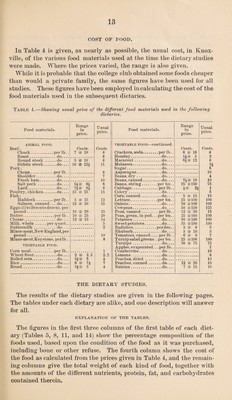
![In all cases where the amount of food was large or of unknown com¬ position, such as native beef, pork, milk, butter, flour, corn meal, etc., samples were analyzed in connection with the dietary study. In all such cases the letter a is placed after the name of the food material. These analyses are given in Tables 1 to 3. Where the article was not analyzed its percentage composition was taken from the table of average composition of American foods in Bulletin Ho. 21 of this Office. The weights of the dried table and kitchen waste1 and their compo¬ sition are given in the last line of the table. The second table in each dietary (Tables 6, 9, 12, and 15) shows the relative proportions of the several classes of food materials in the diet¬ ary and nutrients furnished by each class. It tells its story so plainly as to require little comment. The last table in each dietary (Tables 7, 10, 13, and 16) gives the nutrients and fuel values of food purchased, in table and kitchen wastes, and in the portion actually eaten. The estimates of animal and vege¬ table nutrients in the waste are confuted as below described. In estimating the fuel values of the nutritive ingredients, the protein and carbohydrates are assumed to contain 4.1 and the fats 9.3 calories of potential energy per gram. It was not practicable in the collection of the wastes in these experi¬ ments to distinguish between that which came from animal and that from vegetable food. It is, however, possible to estimate with more or less accuracy how much of the nutritive ingredients came from the animal and how much from the vegetable foods. As there were prac¬ tically no carbohydrates in any of the animal foods except milk and cheese, and but little in these, it is reasonably accurate to assume that all the waste carbohydrates came from the vegetable foods. It will also be fairly accurate to assume that there are the same proportions of protein, fat, and carbohydrates in the vegetable waste as in the whole vegetable food purchased. In other words, the amount of vegetable protein and vegetable fat in the waste will bear nearly the same ratio to the total amount of vegetable protein and fat in the food purchased that the carbohydrates of the waste do to the total carbo¬ hydrates of the vegetable food. Taking the percentages of the weights of the carbohydrates in the total waste as the measure of the protein and fats in the vegetable wastes, the actual weights of protein and fat in the latter are readily calculated. Subtracting these weights of vegetable protein and fat from the total weight of these ingredients in :T]ie words “refuse” and “waste” are used somewhat indiscriminately. In gen¬ eral, refuse in animal food represents inedible material, although hone, tendon, etc., which are classed as refuse, may he utilized for soup. The refuse of vegetable foods, such as parings, seeds, etc., represent not only inedible material, but also more or less of edible material. The waste includes the edible portion of the food, as pieces of meat, bread, etc., which might be saved, but is actually thrown away with the refuse.](https://iiif.wellcomecollection.org/image/b30472489_0016.jp2/full/800%2C/0/default.jpg)